
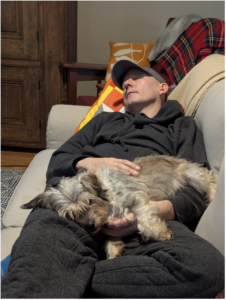
I am writing from the West Coast for the holiday season, visiting family in Portland, Oregon, where I began my professional career as Chorus Master at Portland Opera. I am surrounded by my husband Micah’s entire clan, including our three nephews, all considerably larger and more talkative than when I last saw them. Micah’s parents’ house is currently the scene of much nominal confusion: whether distinguishing between our identical twin nephews (adorable three-year olds somewhat unhelpfully named Asher and Aiden), responding to the wrong person (the family unit includes three Robs), or dealing with the addition to the family of a new dog, whose name — or at least its correct spelling — has not yet been fully settled.
by Any other Word
Names, titles, and the power they possess have been on my mind lately, drawing my attention in programming, casting, staffing, and the news. While Shakespeare reminds us that identity and character are much more than just a label … “What’s in a name? That which we call a rose, By any other word would smell as sweet.” [Romeo and Juliet] … the names we use also carry great inherent power, shaping identity, perception, and culture.
We will reveal our complete casting for the upcoming season, including the two Hupper Family Festival Artists, shortly. We created this new tier of our training program, made possible by the generosity of the Hupper Family, to recognize Resident Artist alumni who have made a real impact on our audiences and staff and whose careers we want to further invest in. Over time, we hope the Hupper Family Festival Artist name becomes synonymous across the industry with the extraordinary combination of talent, stage presence, and professionalism we expect of these exceptional artists. Watch out for the announcement of these two Festival favorites in the new year.
Titles are important for our staff as well: spurred by the sad but anticipated departure of our beloved Executive Director Andi Lyons, we’ve taken the time to update some of our staff’s titles to more fully reflect the roles and responsibilities they’ve taken on over recent months. These titles mean a lot not just to the staff personally, but in making their roles clear to the many seasonal employees we bring in each summer. As you know, we take great pride in our staff and their dedication to our mission, and think carefully about the fine professional example and mentorship they provide for our seasonal employees and Apprentices.
Take a Chance on A Stranger
I also encourage you to think carefully about the titles in our season and what they mean to you. We try to bring you an exciting mix of familiar and unfamiliar names every season while ensuring everything we present meets the Glimmerglass standards you have come to expect. If any of the names are unfamiliar, I heartily encourage you to take a chance and “meet some strangers.” You won’t regret it.
Oklahoma! and Madame Butterfly are familiar titles to almost anyone with a passing interest in the theater, instantly evoking feelings of nostalgic Americana and heartbreaking operatic tragedy — along with big tunes we all know and love. Francesca Zambello’s productions have also developed a distinctive name and reputation — we can rely on Francesca’s direction to fulfill and surpass all the expectations we may arrive with, bringing energy, insight, and stunning visuals to everything she directs.
You may also have noticed that we are calling our production of Mozart’s comic masterpiece Così, rather than its more usual Così fan tutte. This was a deliberate choice — whereas the original title carries innate connotations of a one-sided and even misogynistic view of the trials and tribulations of love and fidelity, Director Eric Einhorn and Translator Kelley Rourke are seeking to reframe Don Alfonso’s social experiment to apply to all four protagonists — not just the women — matching the emotional and psychological depths Mozart’s music explores for both genders. Our team’s point of departure was really the piece’s original subtitle, La scuola degli amanti, or “The School for Lovers,” and in the witty contemporary setting we are using, this masterpiece’s social commentary will feel just as immediate and relevant as it did in 1790.
The great soprano Carol Vaness, renowned for her interpretations of Mozart heroines, sings Fiordiligi’s great aria, “Per pietà, ben mio, perdona.”
Soprano Amanda Batista, who makes her Glimmerglass debut as this season’s Fiordiligi, performs an aria from La bohème.
Fellow Travelers may be a title you have not seen on stage before, but the name itself may be familiar from the recent Paramount+ miniseries adaptation starring Matt Bomer and Jonathan Bailey. To those on the inside of the opera world, this is one of the most successful new works of the past decade, propelling the name of composer Gregory Spears to the forefront of the contemporary operatic firmament. It can be daunting to take a chance on an unfamiliar name, but it is part of our mission to bring you the very best works from recent years — Fellow Travelers is undoubtedly one of them. You can learn more about this production (including performances featuring this season’s Hawkins Fuller, baritone Joseph Lattanzi) in this Works & Process seminar held some weeks ago at the Guggenheim.
Names feature throughout Alan Louis Smith’s wonderful song cycle, Vignettes: Ellis Island. Each of its twenty miniature musical portraits carries the name of a real person … Manny, Kaj, Dora, Max, Anna, etc. … and the song texts are extracts from their own oral histories. These colorful characters, whose portraits sometimes last less than a minute, have vivid personalities and real emotions beautifully captured by Smith which extend far beyond the dry information in their arrival records: “Max Mason, born 1912, emigrated from the Ukraine in 1921, age 8,” “Martha Kallens Reininger, born 1911, emigrated from Germany in 1924, age 13,” “Irena Leonidoff Spross, born in 1920, emigrated from Russian via France in 1929, age 8.” They are all fascinating people and will make you alternately laugh and cry.
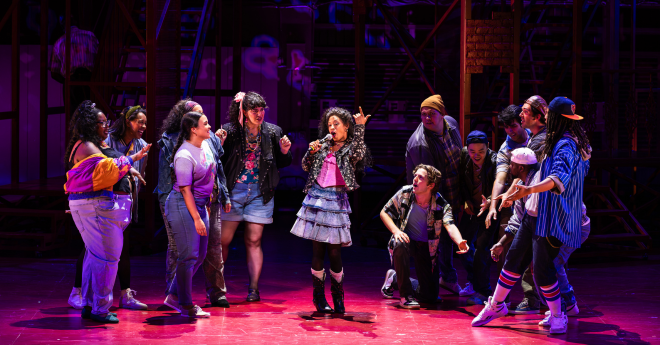
Perhaps Happy End is a title you have never encountered before, but it might surprise you to know that the last major Broadway production from 1977 featured Back to the Future’s Christopher Lloyd on crutches (he injured himself at the dress rehearsal) and a young Meryl Streep, fresh out of college. Imagine what names of this magnitude would bring to a production today — I suppose even Meryl Streep had to start somewhere.
Here is Christopher Lloyd performing “The Bilbao Song” at the ’77 Tony Awards.
What does glimmerglass mean to you?
Names can also be used for nefarious purposes, both individually and collectively. Our newsfeeds have sadly seen many instances of name-calling, othering, and refusals to acknowledge people’s chosen or preferred names and identities in recent months — from both sides of the political aisle. While names do not define our essence or character, the names we give and use have great power and significance, and we must take notice when they are used with ill intent or malice.
I feel I must remark on one specific way in which the power of a name has been seen in action recently. As a former employee of the Kennedy Center, I worked each day with great pride knowing I was part of the legacy of a President who had both taken us to the moon and championed the role of the arts and culture in American life. The recent name change is an affront to the living memorial of a great American. Conditions at the Center are very challenging right now, as multiple articles have reported in recent weeks, and this move will not help matters. We send Francesca, currently doing phenomenal work at Washington National Opera as its Artistic Director, and Timothy O’Leary, its General Director and an incredible friend and colleague, all our support and well-wishes as they navigate this impossible terrain.
To end on a brighter note, why not think about and let us know in the comments what the name “Glimmerglass” means to you? When you think of The Glimmerglass Festival, what comes to mind about the experience you look forward to each summer? As we shape our next half-century and build on the legacy of our last, we want to know what brings you back to campus. How would you like to see Glimmerglass evolve in the years to come? And as you contemplate that, you can help us do all those things by making a year-end donation, by encouraging friends to join you this season (maybe by purchasing a Glimmerglass gift card), and by planning your strategy for single-ticket day, coming up on January 26.
One final thought around names. There is still time before the year-end to help us achieve our $7.5M campaign goal — now within tantalizingly close reach — either by adding your name to our donor wall or by naming a seat in the theater for you or a loved one. These are ways in which a name can have lasting significance and impact.
We wish you the happiest of holidays and every best wish for the new year ahead. Celebrate in style, and we’ll see you this summer!