
From the Dramaturg’s Desk: A Deep Dive into COSÌ
PROGRAM NOTE: And Just Like That
Mozart and Da Ponte’s school for romantics, cynics, and everyone in between
By Kelley Rourke
“Così fan tutte le belle!” (“Thus do all beautiful women!”) So says Basilio in The Marriage of Figaro (1786) as he catches the lady of the house in what appears to be a compromising position. The first of three operas written by Wolfgang Amadeus Mozart and Lorenzo Da Ponte, Figaro takes place over the course of one “crazy day” in which the men’s cluelessness, jealousy, and infidelity drive the women to band together to teach them a lesson.
The following year, Da Ponte and Mozart premiered Don Giovanni (1787), the story of a man whose appetites outpace his morals. To frame their final collaboration, they returned to Basilio’s motto from the earlier opera: Così fan tutte (1790). In this story, two young couples’ profession of undying love is subject to a cold experiment, set in motion by a cynical philosopher, aided by a feisty chambermaid, and accompanied by a score that many judge to be among the finest Mozart ever produced.
“While all Mozart’s operas are desert island discs for me, Così is probably my favorite, and yet it is often the most elusive of his ‘Big Four’ for today’s audiences,” says Artistic & General Director Rob Ainsley. “The purest musical ‘Classicism’ finds its ineffable beauty in simplicity, balance, and refinement. In visual art, most people respond more immediately to the heroism of Michelangelo’s ‘David’ and his Sistine Chapel, and find the great works of Raphael or even an in-person encounter with Da Vinci’s ‘Mona Lisa’ to be initially underwhelming in comparison. Yet spend enough time with them, and they yield unutterable rewards. The Sturm und Drang of Don Giovanni and the works of Beethoven possess this Michelangelo-esque heroic quality, but the more Classical Così functions at an entirely human scale. The simplicity of its musical means, the perfection of its orchestration, the total grasp of form, the unique understanding of the capacities and qualities of the human voice, the balance and endless invention of the ensembles exemplify the Renaissance ideal that ‘man is the measure of all things.’ As a true synthesis of text, drama, and music, Così has never been surpassed, and it transforms Da Ponte’s cynical morality play into a complete exploration of what it means to be fully human.”
Mozart had settled in Vienna in 1781, after an unfriendly break with his previous employer. That same year, Da Ponte, who had recently been exiled from his native Venice, was appointed poet to Vienna’s court theater. Although Mozart’s rapidly growing oeuvre already included more than ten works for the stage, only one of those (Idomeneo) makes regular appearances today. Da Ponte, for his part, was still a novice librettist. But together, this brilliant and bawdy pair took an enormous leap forward, creating three operas lauded not only for their witty words and sublime music but also for their acute analysis of human behavior.
Even as they created characters who rail against women, Mozart and Da Ponte set them in worlds in which questionable choices come at least as naturally to men. Figaro’s unflattering portrayal of the aristocracy features a Count who believes his position entitles him to sleep with any woman he wants, leaving his neglected wife to wonder what happened to the love they once shared. Don Giovanni (1787) might as well have been titled “Thus the Don Does Them All.” The title character’s nihilism is juxtaposed with the range of passions he evokes in the opera’s women.
Così had only a handful of performances in Vienna during Mozart’s lifetime; in those early years, it was critiqued as frivolous, while later generations found it downright immoral. It has played in various adaptations that attempted to doctor the scenario, including Mädchenrache (A Girl’s Revenge), Die Zauberprobe (The Magic Test), Mädchen sind Mädchen (Girls Will Be Girls), Die verfängliche Wette (The Tricky Bet), and So machen es alle (That’s how everyone does it), among others.
Musicologist Joseph Kerman neatly summed up the arguments for and against Così: “Mozart’s music clarifies and damns Da Ponte’s cynicism, and so spoils his immaculate play… Alfonso wanted to show that feelings change; Da Ponte wanted to expose them as meaningless; Mozart wanted to define their quality, whether they last or not. So in the end it is a wry joke on Da Ponte: fickleness seems irrelevant and relatively unreal; Mozart’s point is that emotions touch anyhow, even if they soon alter.”
In 1922, Così fan tutte finally had its American premiere, decades after the debuts of the other two Mozart/Da Ponte operas. At the Metropolitan Opera, a smaller stage-upon-the-stage was erected to give a feeling of intimacy to an opera “that under ordinary conditions it would be swamped or submerged in the great spaces of the Metropolitan stage” (New York Times). Così was given just 12 performances in the 1920s before disappearing again. But in 1951, Alfred Lunt’s new production, given in English, allowed audiences to appreciate the sparkling comedy along with the brilliant score.
“I remember the first time I heard Mozart recitative in English,” says Ainsley. “It was revelatory – it almost felt like the singers weren’t singing at all, and yet every word made it to the back of the hall without effort, with Mozart’s naturally perfect pacing and intent preserved. After spending so long working on my Italian and trying so hard to make the beautiful stream of sounds seem idiomatic to my teachers, suddenly I understood what they were trying to achieve – but for whose benefit? It would have been a particularly odd choice to update Così to a modern American college setting in celebration of America’s 250th anniversary and to then have it sung in Italian. Opera being sung in anything other than the native language of its intended audience is in itself an anachronism – Mozart would have been shocked at the idea.”
Eric Einhorn and I first started thinking together about Così in 2019, when Francesca Zambello asked us to create a fresh, abridged version for the Glimmerglass Pavilion. We considered how to answer the various critiques that had been leveled against the opera’s story. At one point we even discussed swapping the men’s and women’s roles, but quickly decided against that idea — who wants to hear a tenor sing “Come scoglio”?
Eventually, we hit on an American college as an apt container for Mozart and Da Ponte’s “school for lovers.” Early adulthood is a time of intense drama and exploration, as young men and women leave childhood behind and begin to engage with the world on their own terms. It’s a sheltered environment in which the occasional bad choice is an expected part of growth. The collegiate setting also supplied the public/private spaces that are key to the story; the original philosophical debate, which begins in a coffee house, transfers easily to a campus setting.
Due to the COVID-19 pandemic, that production never made it to the Pavilion. Last year, Rob invited us to revisit the concept, this time for a full performance in the opera house. “By moving this production from the Pavilion to Opera House, Kelley and I were able to delve even deeper into the pre-social media college world of the mid-1990s,” says Einhorn. “We chose this period so that the characters could make their choices without the added threat of online permanence, yet keep us out of the more ‘visually stereotype-able’ 1970s and 80s. College is a place where the stakes are higher because we, as newly-independent young adults, are trying to decipher and assert who we want to be now that we’re away from home. All of this provides a strong structure onto which we can hang the intense emotion and pathos of the score. While Figaro takes places over “one crazy day,” our Così takes place over an even crazier one! Così is typically an opera about its six characters, with the chorus making very brief, ancillary appearances. Kelley and I wanted to widen the world we created by including the chorus (the greater student body) into much more of the story. The dubious choices we make in college are one thing when done privately, but what happens to your decision-making ability when your entire community could be watching?”
In Così, the philosopher Alfonso, like Basilio before him, is dubious about women’s virtue. However, it is the men who launch the series of betrayals that set the plot in motion. So why frame the evening as a critique of women’s behavior? We briefly considered swapping the feminine “tutte” for the masculine “tutti,” but in the end decided to take gender out of the frame altogether. Before the evening is out, both sexes reveal their basest instincts and their highest natures: Così — or, “just like that.”
Like Figaro, Cosi was written for Vienna’s Burgtheater, an intimate space well-suited to a story that eschews larger-than-life “operatic” events — no spectacular bloodbaths here — for something far more devastating. Da Ponte’s “school for lovers” is an advanced chemistry lesson that comes off better as a roundtable seminar than a large-hall lecture, making it ideally suited for the intimate Alice Busch Opera Theater. As our instruction concludes, we, like the four young lovers, are sadder but wiser. How well can people ever know each other, we wonder? Not as well, perhaps, as Mozart and Da Ponte knew us.
Where or When
Da Ponte’s libretto, set in the time of its creators, name-drops a few locations: The opera, written for a Viennese audience, was set in Naples, a sunny southern Italian seashore which might legitimately have a freewheeling vacation feel for our four protagonists from the northern, landlocked town of Ferrara. Beginning around the 15th century, Albanians began crossing the Adriatic Sea to escape the Ottoman Empire; the men’s disguises in the original libretto play on stereotypes of these immigrants as appealingly exotic.
Still, compared with Le nozze di Figaro and Don Giovanni, Così fan tutte’s action is relatively unmoored; the conventions of a specific time, place and social milieu don’t play a major role in the unfolding plot. As a result, the opera has inspired many imaginative approaches. Peter Sellars’ modern settings of the Mozart-Da Ponte trilogy included Cosi set mostly in “Despina’s Diner,” with Alfonso played as a Vietnam Vet. Phelim McDermott’s recent production is set in Coney Island in the 1950s. Joel Ivany’s “transladapation,” A Little Too Cozy, reimagines the story as a reality TV show. Wojciech Faruga’s production for Polish Opera sets the story in 1970s America, with the sexual revolution and the Vietnam War as backdrop. Following a 1982 production set in the time of the creators, Sir Jonathan Miller created a modern version for Covent Garden in 1985, which continued to evolve to keep pace with technology. Jan Philipp Gloger’s 2016 meta staging for Royal Opera House begins at the end of the opera, with couples who have taken in the show and want to discuss what they’ve just seen.
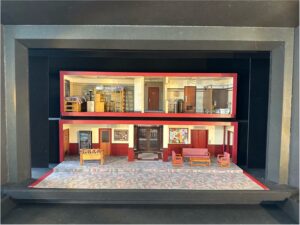
In 2020, Kelley Rourke and Eric Einhorn developed a 90-minute riff on Così that set the show in an American college, with a twist: part one took place during the protagonist’s senior year, part two at the 20-year reunion. Commissioned by Glimmerglass for its Pavilion Stage, the planned premiere was cancelled due to the pandemic, but Rourke’s adaptation — with a “coffee-house band” orchestration by Nicolás Lell Benavides — premiered at Florentine Opera, in a production by Jill Anna Ponasik. For this year’s mainstage production, Rourke & Einhorn retained the college setting but kept the narrative centered on the events of a single evening.
Party Like It’s 1994
Britannica.com is one of many sites offering a timeline of the 1990s. The year 1994 saw the launch of both Friends and the online bookseller Amazon.com. Members of the student population of Sunbury College at the time of our opera were in grade school for the collapse of the Soviet Union, the launch of the Hubble Space Telescope, The Persian Gulf War, and the riots that followed the acquittal of the policemen who killed Rodney King. As of 1993, AIDS was the leading cause of death for all Americans ages 25-44. Harry Potter, Viagra, and Google were still a few years away, as were smartphones and social media. Weird History offers a four-hour year-by-year video binge of 1990s events and culture, from the rise of “the Rachel” (a popular hairstyle based on a character from Friends) to the introduction of the Euro.
Dating in the 1990s
Popular dating books give a window into dating in the days when flirtation happened in the real world, not the virtual one. John Gray’s Men are from Mars, Women are from Venus (1992) suggests that men and women are fundamentally different, experiencing and responding to stress, love, and emotional needs differently; Mars and Venus on a Date (1997) offers advice for navigating these differences. Ellen Fein and Sherrie Schneider’s The Rules: Time-tested Secrets for Capturing the Heart of Mr. Right (1995), like many dating books of the time, is aimed at women and emphasizes that success will come to those who are easy to be with and hard to get. Act Like a Lady, Think Like a Man offers a man’s perspective on how women should approach dating. A 1997 article in SFGate.com discussed “Dating in the 90s: Etiquette and the New Chivalry.” If you prefer, get your Relationship Advice from Your Favorite 90s Throwback Songs.
1990s on the Dance Floor
In the Halloween party at the center of our adaptation, mismatched lovers sway to tunes by Mozart, given new lyrics inspired by late 20th-century pop. For a reminder of what kids were really listening to, director Eric Einhorn put together this playlist.
Opera in the Vernacular
More than 40 years after their first, controversial introduction, supertitles have become ubiquitous, and opera performed in its original language has become the norm. But contrary to what many assume, this practice does not necessarily represent “the composer’s intent.” For composers like Verdi and Puccini, having their work translated and performed in other languages was a mark of success, and until very recently, major European opera houses privileged the language of the audience over the language of the composer. In this piece, librettist and translator Kelley Rourke reviews shifting attitudes toward the languages of performance.
Sounds of the Homeland
In America, opera was a cultural artifact brought over by immigrant communities. In the 1820s, British touring companies presented English works and English adaptations of Italian operas throughout the northeast. Manuel Garcia’s Italian Opera Company arrived in New York on November 6, 1825 and opened three days later with Rossini’s Il barbiere di Siviglia, a work already well-known (albeit in English) to much of the audience; Garcia went on to give New York its first Italian performances of nine popular works. Although American audiences embraced the performances, they were put off by the unfamiliar language. A critic from the New York Mirror grumbled that “the Italian opera threatens to exclude the English from the stage.”
In early nineteenth-century New Orleans, opera in the vernacular meant French opera. The first Théâtre d’Orléans, which opened in October 1815, presented popular works by Boieldieu, Spontini, Auber and other French composers. The newest territory of the United States was determined to hold on to its culture and language, even in the face of Yankee occupation, and opera became a rallying-point for intensified Gallic self-awareness. Under impresario John Davis, New Orleans saw more than 700 performances of about 150 operas. His mission was showing off French opera, “the pride and hope of the generation raised on the ruins of the old French regime.” This mission took him all over the country, playing to enthusiastic French emigres in Philadelphia, New York, Baltimore, and Boston.
By the mid-nineteenth century, opera was becoming an established part of the cultural scene in most major American cities. The type of presentation was often a reflection of the city’s political, social, artistic, and intellectual values. Philadelphia was originally colonized by touring companies presenting English farces, but European immigrants “supplied the theaters with admirable orchestras and modified the manners of the town.” By the 1830s, operas were performed in French, German, and English. The choice of language was mainly dependent on the singers available.
A National Institution / An International Repertory
In 1880, fifty-two of New York’s leading citizens subscribed $100,000 each to what was to become the Metropolitan Opera. The new theater opened on October 22, 1883, with Gounod’s Faust, sung in Italian. The choice of Italian for even a French work demonstrates that Italy had become established in the mind of New York’s elite as the official source of opera. Impresario Henry Abbey programmed mostly Italian pieces but also included works such as Carmen, Mignon, and Lohengrin in Italian translation.
In 1884, the Met’s new manager, Leopold Damrosch, adopted a new language policy designed to appeal to a large, intellectual segment of the population: For the next seven years, the repertory consisted mainly of works by Wagner and other Germans, but Damrosch followed Abbey’s policy of translating other pieces (including Rigoletto, Aida, and Norma) into the prevailing “house” language — now German. One could argue that this policy was actually part of America’s vernacular opera tradition: at that time, New York may have had more German-speaking inhabitants than any city after Vienna and Berlin.
After the German period, records show that opera at the Met was usually produced in its original language. The exceptions were unfamiliar works, such as Liszt’s St. Elizabeth (1918), Mussorsky’s Khovanshchina (1950), and Berg’s Wozzeck (1959), which were given in English for their first performances. As a major international venue for opera, the Met largely justified its original-language policies on practical grounds: many of the singers presented at the Met were not native English-speakers.
For the first 100+ years of its history, the Met was a major provider of opera across the U.S., touring from Maine to San Francisco. For Americans outside the touring circuit, Saturday broadcasts, which began in 1931 and continue today, provided a steady “opera fix” — albeit one that required some advance study to follow the story, since the Met performed in the original language. For many opera fans, the need for additional engagement were part of the allure.
Opera Theater in America
As the American appetite for opera grew, so did the number of opera companies across the country. Some sought to imitate the Met’s practices, with lavish period productions and original languages, but others clamored for opera in English. Herbert Graf, who led opera houses in Philadelphia and New York, wrote, “It still seems very strange to me that anyone who believes in the basic function of the theater…can deny in principle its need and its right to be understood.” Although he recognized that a work was changed in many ways by translation, he argued that, “Opera is written and performed to be understood by an audience, and no composer ever preferred subtleties of prosody to full comprehension by the audience.” The movement for opera in the vernacular became tied to the development of a renewed vision of opera: opera as theater, with intimate venues, imaginative staging, and high dramatic/theatrical values.
Director and translator Boris Goldovsy described two resident opera traditions: “We have an international style and what I call an opera theater style. We want to hear the great singers… And since we want to hear them, we want to hear them in the way that they produce the best kind of sound, usually in the original language which they have learned. And since we have many American singers who sing with them, we teach the Americans to sing [foreign languages]. But we teach them so they can participate in the international style. That makes perfectly good sense, but we have the other style, the opera theater style…Then you have the advantage of audiences that can understand the words, and you can accomplish better theater because the audience becomes acutely aware of bad acting.” Many American opera festivals — including Chautauqua Opera, Opera Theatre of Saint Louis, Des Moines Metro Opera, and Glimmerglass — originally had opera in English as part of their mission statements.
Supertitles Arrive
In fall of 1983, Opera News tersely reported an experiment taking place at New York City Opera. Beverly Sills, NYCO’s singer-turned-director, had seen projected translations in a Canadian Opera Company production of Strauss’ Elektra in January of the same year and planned to introduce projected titles for NYCO’s fall 1983 Cendrillon. For Sills and other “popularizers,” titles were the long-awaited answer to the language question. “I think we should eliminate as many barriers as possible to opera. With subtitles, you can have opera in the language the composer wrote and relax, instead of straining to understand.”
The NYCO audience responded enthusiastically to projected titles, and Sills attributed a substantially increased subscription base, in part, to the new technology. In 1996, an independent survey of opera neophytes confirmed audience enthusiasm for titles. Participants expressed relief at being able to follow the plot and understand the jokes. For at least one patron, titles motivated attendance: “As soon as I knew there were surtitles, I went [to the opera] the very next month.”
But not everyone welcomed this new addition to the operatic experience. The most famous declaration against titles came from James Levine, artistic director of the Metropolitan Opera, in 1985. “Over my dead body will they show these things at this house. I cannot imagine not wanting the audience riveted on the performers at every moment.” Others echoed his sentiments: “Well-intentioned though they are, Supertitles give a false sense that enjoying a live opera performance means simply getting the words straight…Supertitles wrest the audience away from the action toward a disembodied shelf of words floating above the stage.”
An Option Need Not Be an Obligation
Today, it is hard to imagine opera without supertitles. They are a standard feature in nearly every American opera company, even those producing opera in English. At Milan’s La Scala (which was still performing Wagner in Italian in 2000), titles were added in 2004. With the widespread utilization of supertitles, combined with relative ease of air travel, a near universal practice of performing in the original language makes practical sense, especially for companies presenting only a handful of performances.
Interestingly, many now see move away from the vernacular not just as a practical solution, but as an aesthetic imperative, one in keeping with “the composer’s intent.” While many enjoy the sonic qualities of certain foreign languages, the marriage of melody and the sounds of its original language were not sacrosanct for the composers who now make up much of the canon. To give but one example — in Verdi’s lifetime, Aida was performed in English, French, German, Hungarian, Polish, Russian, Czech, Rumanian, Swedish, Croatian, Lettish and Danish. Today’s preference for the original language over the vernacular is not historically accurate performance practice; it is a distinctly modern fetish.
Time marches on. There is no going back to the days before supertitles, and it’s a good thing; without their popularizing quality, opera audiences in America would be far less robust. For a variety of reasons, performance in the original language, with supertitles, remains the best choice for many productions. But — particularly for comedies — there is something lost when audiences cannot connect directly to the words as the characters utter them.
In 1992, Glimmerglass leadership concluded that it could better serve its audiences — and the art form — by adopting supertitles and performing (mostly) in the original language. But unlike our previous practice of performing in English, this was not written into the mission statement. Supertitles give us options, and occasionally we’ve exercised our option to perform in English translation, especially for comedies (King for a Day, Ariadne in Naxos) and works that include long spoken dialogue scenes (The Magic Flute, Bluebeard).
Rob Ainsley, Artistic Director of The Glimmerglass Festival, felt English would be the best choice for the 2026 production of Così, for several reasons. “I remember the first time I heard Mozart recitative in English,” he says. “It was revelatory – it almost felt like the singers weren’t singing at all, and yet every word made it to the back of the hall without effort, with Mozart’s naturally perfect pacing and intent preserved. After spending so long working on my Italian and trying so hard to make the beautiful stream of sounds seem idiomatic to my teachers, suddenly I understood what they were trying to achieve – but for whose benefit? It would have been a particularly odd choice to update Così to a modern American college setting in celebration of America’s 250th anniversary and to then have it sung in Italian. Opera being sung in anything other than the native language of its intended audience is in itself an anachronism – Mozart would have been shocked at the idea.”
Così fan tutte Goes to College
Così fan tutte, the title of Mozart and Da Ponte’s opera, translates to “Women are all like that.” It focuses on a plot of romantic confusion, as an older cynic, Don Alfonso, challenges two young men to test their lovers’ loyalty. The young men “go away to war” only to return in disguise and attempt to seduce each other’s partner in order to prove that their women are not adulterous — not “like that.” Hijinks, hilarity, and heightened emotions compound as the story explores the nature of love, lust, and loyalty.
This year The Glimmerglass Festival will produce Così, a modern adaptation set 200+ years after Così fan tutte’s original composition. In conversation with Dramaturgy/Titles Apprentice Kevin Harris, librettist and dramaturg Kelley Rourke explains how and why her version of the opera not only goes to school, it enrolls in college.
KH: How did you decide on the college setting?
KR: The full original title is Così fan tutte, or La scuola degli amanti — “the school for lovers.” It is an experiment in which two older, supposedly wiser characters school two pairs of naive romantics. A college setting provides the perfect laboratory: college is a time of experimentation, and also a time when young people are very sure of themselves. It is also a time when everything seems heightened. The perceived high stakes for the characters meets the high drama of the music.
Within the college setting, we were also excited about placing the action in the midst of of a costume party. One of the challenges with the original is that the women are completely taken in by the men’s disguises, but normally these disguises aren’t supposed to read — to the women, at least — as costumes. This presents a hurdle to the audience’s buy-in: if the costumes are so extreme that the men’s girlfriends don’t recognize them, they’re probably ridiculous. We leaned into that idea and put everyone in a ridiculous costume, which somehow makes sense of everything.
KH: What about the year? Why the 1990s?
KR: Today, with the ubiquity of social media, one mistake can get you canceled if it goes viral. We wanted our characters to have the freedom you had before everyone had smartphones. We didn’t go earlier because the clothing of the 80s and 70s is so visually distinctive, those periods can almost feel like caricatures. Coincidentally, we landed in the year I completed college, which gave me a head start on research.
KH: Were there any particular challenges with the setting?
KR: A college Halloween party gives you an easy justification for all these mistaken identities and experimental behaviors. It also dangles a potential motivation that is a little too easy: alcohol. Initially, we considered placing all the action in a fraternity or sorority house party, but we didn’t want people to be able to say, “Oops, sorry, I did that because I was drunk.” We wanted the exploration to come from something real, so we moved our party into the more regulated setting of a dorm.
KH: Is there anything about this process that has helped redefine yourself as an artist?
KR: Così is a piece about people who believe they know everything there is to know about the human heart. In the end, we are all taken to surprising places by our emotions and the emotions of others. For me, that’s the continuing lesson of Così.
Clothes Make the Man?
Così fan tutte’s plot relies on mistaken identities: Under false pretenses, Guglielmo and Ferrando leave their girlfriends, then return, in disguise, to test the women’s fidelity. Da Ponte’s original libretto has them appear as “Albanians”; subsequent productions have had the men appear in a variety of costumes, ranging from circus sideshow workers to heavy metal rockers. Our production, set in the midst of a Halloween party, allows everyone to join in the fun. Costume designer Beth Goldenberg discusses how she arrived at the protagonists’ looks.
Halloween gives young people who are still discovering who they are the opportunity to explore aspects of their identity more freely than they can under the ordinary circumstances and structures of society. We chose our characters’ Halloween costumes to reflect their journeys through the piece.
As the opera opens, the committed couples are planning to attend the party as an Alice in Wonderland quartet. Ferrando is working on his “Mad Hatter” look, while Guglielmo stitches hearts on a playing card. Fiordiligi and Dorabella complete the foursome as Alice and the White Rabbit, respectively. When the men leave, it breaks apart the group costume plan.
Fiordiligi and Dorabella, who have each identified so strongly as part of a couple, are newly alone and freed to go on their own individual journeys of personal discovery through a topsy-turvy Wonderland of what they thought was impossible.
College football jocks Ferrando and Guglielmo choose new Halloween costume disguises that are members of a traveling circus, implying they are arriving in a new place to charm the locals, but they are also exploring aspects of their identities they usually feel pressure to contain. Ferrando, the steady, grounded boyfriend and athlete, lets loose his more silly side as a clown, charming the usually serious and disciplined Fiordiligi, to her own surprise. Guglielmo, the quarterback with a plan for everything, becomes a comically over-muscled circus strongman, led by his emotions, and matching Dorabella’s strong passions.