
From the Dramaturg’s Desk: A Deep Dive into Fellow Travelers
Fellow Travelers
Overview
Recent college graduate Timothy Laughlin arrives in 1950s Washington, D.C., ready to join the fight against Communism. A chance encounter with the handsome State Department official, Hawkins Fuller, results in Tim’s first job and his first romantic relationship with a man. As Tim struggles to reconcile his newfound love with his political, personal, and religious beliefs, Hawkins comes under the watchful eye of McCarthyism and faces charges that could cost him his job and his freedom. Both men must make impossible choices in a story that ends in a stunning act of betrayal.
The creators
Composer Gregory Spears, the subject of a recent New York Times profile, blends romanticism, minimalism, and early music influences into works celebrated for their melodic richness and emotional clarity. Spears’ opera The Righteous (libretto by Tracy K. Smith) premiered at Santa Fe Opera in 2024, earning a “Critic’s Pick” in The New York Times. Earlier collaborations with Smith include Castor and Patience (2022, Cincinnati Opera) and Love Story, commissioned and premiered by the New York Philharmonic. His first opera, Paul’s Case (written with librettist Kathryn Walat), was called “a masterpiece” by The New York Observer. Beyond opera, Spears has developed a wide-ranging catalog of orchestral, choral, and chamber works.
Greg Pierce is a playwright, librettist, and lyricist based in New York City. He wrote the libretto for the opera The Hours with composer Kevin Puts, commissioned and produced by the Metropolitan Opera and The Philadelphia Orchestra. With composer Nico Muhly, he wrote the opera-film The Glitch, commissioned by Catapult Opera. He has written two musicals with composer John Kander, The Landing and Kid Victory, which was co-produced by the Vineyard Theatre and Signature Theatre.
G. Sterling Zinsmeyer is a veteran producer of films and stage productions. His interest has been to tell the stories of our gay community. His film production credits include The Deception, which premiered at the 2015 Santa Fe Film Festival, and Latter Days, which was released to wide acclaim in 2004. Latter Days has since been selected by The Library of Congress to be archived in their collection of important American films. After reading Thomas Mallon’s novel Fellow Travelers, Zinsmeyer enlisted Kevin Newbury to help him bring this story to the stage as a chamber opera.
The source
Thomas Mallon’s 2008 novel, a work of historical fiction served as the source for both the opera and the 2023 miniseries, which received a Peabody Award and three Emmy Nominations.
A twenty-first century hit
Fellow Travelers premiered in June 2016 at Cincinnati Opera, in a production directed by Kevin Newbury. Subsequent performances included NYC’s PROTOTYPE Festival (2018), Lyric Opera of Chicago (2018), Des Moines Metro Opera, Virginia Opera, and Arizona Opera. Minnesota Opera presented a production by Peter Rothstein in 2018, which has traveled to companies including Boston Lyric Opera, Florida Grand Opera, Opera Columbus, and Madison Opera. A third production premiered at San Francisco’s Opera Parallèle in 2024, led by director Brian Staufenbiel and conductor Nicole Paiement, artistic directors of the company. Fellow Travelers marks its tenth anniversary in 2026 with the launch of a national, multiyear tour; Glimmerglass is one of more than 10 cities that will play host to the production, which is based on Newbury’s original realization of the piece.
Lavender Lament
by Corinna da Foneca-Wolheim
As the time drew near of the June 17, 2016 premiere of Gregory Spears and Greg Pierce’s opera Fellow Travelers about a gay love story in Washington, D.C. during the McCarthy era, the time must have seemed auspicious. After all, since the idea of an operatic adaptation of the
eponymous novel by Thomas Mallon had first been floated, America seemed to be irreversibly set on its course toward equality and acceptance. Barely a year earlier the Supreme Court had issued a landmark ruling on same-sex marriage.
Then, on June 12 a gunman claiming allegiance to the Islamic State entered the Pulse nightclub in Orlando and killed 49 revelers in what became the deadliest incident of anti-gay violence in U.S. history. Pierce recalls receiving the news as the cast and creative team were deep into tech rehearsals at Cincinnati Opera. His libretto has a character gossiping about a man who lost his job for having been caught in the “wrong” bar. Half a century of presumed progress later, dozens had lost their lives for much the same reason. “We started to hear everything differently,” Pierce says. “Suddenly there were these parallels.”
Fellow Travelers presents a slice of American history that is rarely examined. It is set during the “Lavender Scare” of the 1950s, when anti-Communist paranoia fueled the targeted persecution of gay and lesbian government workers, who were considered easy targets for blackmail by
enemy agents. But the instant popular and critical success of the opera has a more simple explanation.
Fellow Travelers is a love story that is at once deeply romantic and unsentimental, set to music that manages to be beautiful without appearing glib and sounds familiar, yet fresh.
It follows the emotional maturing of Timothy Laughlin, a wide-eyed Fordham graduate newly arrived in Washington, who falls under the spell of the suave and worldly Hawkins Fuller. Hawk, as he is known, works in the State Department and helps Tim get a job as a speechwriter for a senator close to McCarthy. He also initiates a love affair that is Tim’s first taste of sexual fulfillment.
At work the atmosphere is poisoned by gossip and suspicion. Hawk successfully lies his way through an intimidating cross-examination of his sexuality. His secretary, Mary, is the only sympathetic character, casting a protective eye on the two men’s relationship even as an unplanned pregnancy brings her up against the cold restrictions of her society. And the men’s relationship itself unravels as Tim’s yearning for monogamous security rubs up against Hawk’s promiscuous restlessness. To wrench himself free Tim enlists in the army. While Tim is stationed in Europe Hawk marries the bubbly, oblivious Lucy.
Tim returns to Washington and the two men resume their love affair, but by now the layers of lies and dissimulation have grown stifling. In a stunning act of betrayal, Hawk denounces Tim, ensuring that he is cast out of town and out of Hawk’s life.
The opposition of political forces and private lives is reflected in music that juxtaposes the forward-pressing energy of Minimalism with the sensual arabesques and turns of troubadour music, a tradition that Spears says fascinates him in part because it was developed to express private and forbidden love in a public and ritualized setting. A strong pulse runs through the score, often tapped out on a piano, that conveys something of the mechanical impatience of a newsroom teleprinter of yore. The vocal writing, mirrored in the woodwinds, seems to revolt against that horizontal thrust with music that is extravagantly melismatic, virtuosic and willfully individual.
Spears’ compositional style is studded with references to the past, including Baroque dance forms that capture the courtly formality of the 1950s in social scenes like the office Christmas party. As Hawk sets up the love nest for his trysts with Tim in Act II the music momentarily turns neoclassical with chirpy Stravinskian winds. At this point the men’s relationship is in its second go-around, beset by compromise and disillusionment, and the neoclassical sound captures something of the artifice and rationed nostalgia of their situation.
The transparency of the orchestral texture, created by a chamber-sized ensemble of strings, winds, brass and piano, allows the words of Pierce’s smart dialogue to come through with stenciled clarity. Few composers are as adept as Spears in making conversational American English singable in a way that is both idiomatic and psychologically astute.
Tim’s vocal lines are especially revealing of his inner state: music for someone prone to blushing. Take, for example, his job interview, where the words come out in a nervous jumble, one tripping over the next, his voice an unsteady wobble on some words, or shooting up in a pubescent squawk on others. Or listen to the emotion he is trying so hard to bottle up as he shops for a thank-you gift for Hawk in a bookstore. A melismatic tremor catches him off-guard as he mentions the “great man” he is gift-shopping for; you can guess at the effort it takes for him to iron it out as he repeats the words more plainly.
One reason Fellow Travelers lends itself so well to opera is that the idea of the voice as a conveyor of multilayered meaning is so central to the story. A telling scene is the interrogation of Hawk, designed to test his sexual orientation. Not only is he subjected to a lie detector and ordered to walk the length of the room (“normally. Whatever you would consider normal”), but he is also asked to read out loud. Hawk is first given a news brief, then a passage from Somerset Maugham’s Of Human Bondage, in which the male protagonist burrows into a closet full of women’s dresses.
The idea that a man’s speech melody, rhythm or intonation can reveal carefully concealed truths that could undo his career is chilling, of course. But it’s also wonderfully operatic. As it happens, Hawk reads the first text in dead monotone, but turns the literary extract into a flamboyantly expressive performance that just happens to be set to the same music we first hear when he flirted with Tim on a park bench. His interrogators are clearly none the wiser: he passes the test.
Spears often plays with recurrence of musical material, setting up pairs of scenes as mirror images of each other. Music from Tim’s job interview reappears in a scene involving Senator McCarthy in Act II, reinforcing, as Spears says, “the feeling that Tim has learned a lot: The first time Tim is thinking, ‘here is my future.’ And of course McCarthy is where it’s all curdled.”
For all the oppressive social and political forces weighing on the main characters, the opera’s heart remains wide open — reflected also in the frequent use of guileless octaves and open fifths. Where Mallon’s novel is a dark web of intrigue and blackmail, the opera feels intimate. Pierce remembers being struck by the way Spears set the duet between Tim and Hawk as they dream of Bermuda, shortly before tumbling into bed together. While Hawk reminisces about his adventures there with “bronze boys on the beach — biceps you wouldn’t believe,” Tim is fantasizing about “sand as white as milk.”
“Gregory set it in a way that it overlaps,” Pierce says, “so they’re almost not listening to each other. And then suddenly they are singing together. It was remarkable to me. I thought they would be listening to each other and sharing ideas, but they are really in their own worlds. And that feels so true: When we fall in love we are both seeing the other person but we are also creating that person, we want so badly for them to be ‘that’ person that we aren’t really listening to what they’re saying.”
Corinna da Fonseca-Wollheim writes and speaks about music and listening. Her criticism has appeared in publications including the Atlantic, the New York Times and the Wall Street Journal. Her work has been honored with the Virgil Thomson Award for Outstanding Criticism from ASCAP and a residency at the American Academy in Rome.
More to Explore
Say Their Names:
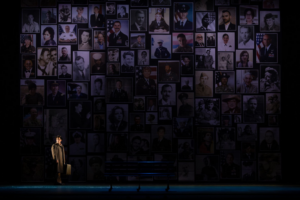
A collaboration between Up Until Now Collective(the producers of the national tour of Fellow Travelers) and the American LGBTQ+ Museum, the Lavender Names Project is a grassroots national archive collecting photos and stories of government workers fired for being LGBTQ+. The touring production of Fellow Travelers honors these people by including their portraits in the set design for the show. Know someone who deserves recognition? Submit your photos and stories through this link.
Who (what? where?) is a Fellow Traveler? From the Russian popuchik, adapted to subtly refer to anyone not officially registered, but otherwise on board with a political agenda or social movement — be it Trotsky, to McCarthy, or modern day Trump struggling to win over the world. Global slang can evolve into our own in many ways, the Irish Times reviews this and other etymological eccentricities.
The Washington Way: D.C. experienced extreme population growth leading into WW2 as people came from all walks of life to apply for egalitarian civil service. But post-war paranoia forced out thousands, especially LGTBQ+ workers, who rapidly lost their safe spaces in and out of the workplace, and were legally barred from government jobs until 1975. A short episode of Hidden Histories from PBS dives deeper into the restrictions of queer civil servants
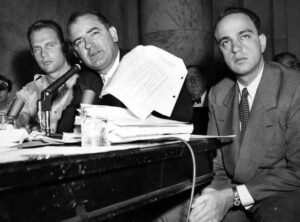
The McCarthy in “McCarthyism”: Senator Joseph McCarthy’s career was relatively short-lived, but his terrifying string of investigations and inquisitions of suspected communists and other subversives in government positions cement him as a powerful, memorable figure in American history. McCarthy’s tenure is a key part in a Cold War Timeline, and his fall from grace came with a quote many will find familiar. Relive the moment with historical footage in this clip from PBS. “Have you no decency sir?”
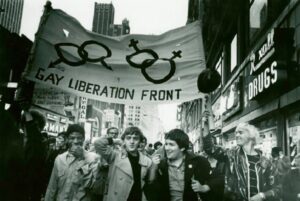
One of the Lads: Before the Lavender Scare, there was the pejorative term “Lavender Lads” used by iconic 1950s homophobe Senator Everett Dirksen. History professor David K. Johnson coined the term “Lavender Scare” for his eponymous 2004 book as a spin on the “Red Scare.” After the 1969 Stonewall riots, New Yorkers wore lavender sashes and armbands as a sign of camaraderie. From then on, lavender has been proudly reclaimed for the queer community. Listen to more about the lavender scare and beyond in the WMHT podcast Pride: in the Name of Love.
Reading Rainbows: James Kirchick’s book Secret City: The Hidden History of Gay Washington looks at how homosexuals and homosexuality shaped each presidential administration since FDR in the 1930s. Eric Cervini takes an in-depth look at the Mattachine Society of Washington – the first organization to fight the persecution of gay federal employees – in The Deviant’s War: The Homosexual vs. the United States of America, a finalist for the Pulitzer Prize. Bonus: Meet Frank Kameny, the man who founded the Mattachine Society of Washington, in this video interview from the Library of Congress.
Material Gays: From the Smithsonian, this free documentary illustrates major queer milestones of the past 100 years through objects on display at the National Museum of American History.
For the Theory Lovers: Jasbir Puar’s 2007 book Terrorist Assemblages: Homonationalism in Queer Times introduced the idea of “homonationalism”: that queer inclusion is not a measure of one nation-state’s progressive values, but rather a malleable construction used to define its citizenry against others, often for imperial gain. For example, in the wake of 9/11, Puar argues that the U.S. intentionally welcomed some expressions of queerness domestically in order to paint the Middle East as a queer terrorist “Other” worthy of political intervention and destruction. Before diving into her book, consider reading “Queer Times, Queer Assemblages,” a journal article from 2005 foregrounding the book, as well as the article “Rethinking Homonationalism” in which she revisits her concept through the Israeli/Palestinian conflictmore recent events (2013).
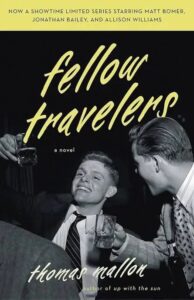
Pages, Stages, and Streams: Boston Lyric Opera interviewed Thomas Mallon about the unexpected evolution of his highly political 2007 novel Fellow Travelers to a dynamic and emotional opera in 2016. The book was also adapted into a passionately provocative miniseries on Showtime in 2023, extending the story beyond the McCarthy era. Read about show creator Ron Nyswaner’s adaptation process in the LA Times. Watch the show on Hulu or Paramount+.
“I know a doctor in New Orleans…” While some white politicians had their hands full oppressing gays in the 20th century, plenty took the time to oppress women as well. In 1910 abortion was banned nationwide, and thousands of women risked death each year through the 1950s seeking illegal abortions. Read more and explore safe birth control options with the history and resources of Planned Parenthood.
Contentment in Bondage. Somerset Maugham’s Of Human Bondage is regarded by many as a masterpiece, and very much a straight novel by a closeted homosexual man under intense scrutiny. The final chapter holds that “the simplest pattern, that in which a man was born, worked, married, had children, and died, was likewise the most perfect.” Like Hawk conforming to survive, queer longing shines through in the novel, but is cut away in a time when being out of the closet was decisively not an option. The interest in this queer perspective of the Maugham’s work has been shared by other performers, particularly in the 2014 stage adaptation of Of Human Bondage.
Straight Scouting: Founded in 1907, the Boy Scouts of America only began allowing gay boys in 2014 and gay adult employees and volunteers in 2015 – despite winning the right to ban gays in U.S. Supreme Court. (Boy Scouts of America v. Dale, 2000) The PBS POV documentary Scout’s Honor (trailer, clip) follows Steven Cozza, a straight Boy Scout who led a national campaign to integrate gay boys leading up to the Supreme Court trial. Multiple documentaries cover the Dale decision and its legacy, including the TV series Liberty on Trial in America: Cases that Defined Freedom. (Apple TV, Amazon, Kanopy) The Dale case continues to echo in recent Supreme Court decisions (see Masterpiece Cakeshop and 303 Creative LLC). James Dale himself, a Scoutmaster fired in 1999 for coming out, weighed in on the current debate on trans youth membership in Scouting for TIME magazine earlier this year. For more queer Scouting history, check out the book Morally Straight: How the Fight for LGBTQ+ Inclusion Changed the Boy Scouts – and America by fellow queer Scout Mike de Socio. Steven Cozza made the cover of the Advocate magazine for his activism and allyship in fighting the Boy Scouts of America’s ban on gay youth and men.
Court Dismissed? Anti-sodomy laws in the U.S. didn’t only regulate the bedroom; they impacted all corners of private and public life, including the workplace, for queer people of all sorts. The ACLU breaks down the history and application of anti-sodomy laws up to Lawrence v. Texas, the 2003 Supreme Court case that found anti-sodomy laws unconstitutional. For a more in-depth look, check out this article from the AMA Journal of Ethics that also covers Bowers v. Hardwick (1986), the one time the Supreme Court directly addressed homosexuals’ right to engage in sodomy. Today, activists fear the current conservative majority on the Court may try to reverse Lawrence v. Texas, allowing 12 states with dormant anti-sodomy laws to enforce them once again.
The front page of the New York Times on June 27, 2003 after the Supreme Court found Texas’s anti-sodomy laws unconstitutional. Facing the camera is the couple at the center of the case, Tyron Garner and John Lawrence.
Different Mediums, Same Travelers
By Kevin Harris, Dramaturgy/Titles Apprentice
Now on its ten-year anniversary tour, Fellow Travelers is still young in the world of opera. The Cold War story of Tim and Hawk originates from Thomas Mallon’s 2007 novel of the same name. The 2016 opera and 2023 mini-series prove that the core story of Fellow Travelers contains a spark of inspiration that rivals the inspiration held in many great myths. A spark that leads to an evolving story of love in the Lavender Scare that can flourish through different mediums, each one providing new angles to explore and new depth to the story.
The book amalgamates the historical institutions and figures of McCarthy era D.C. into the hidden romance of Tim Laughlin and Hawk Fuller. Originally envisioned as a non-fiction book, the secret passion they share is spread amongst a detailed timeline and a broad cast of real-life figures. The book takes the time to build strong ambiance for the period in every scene as the characters walk through a carefully recreated era.
The 2023 show created by Ron Nyswaner vastly expands this timeline. By extending Tim and Hawk’s relationship from the 1950s, through the following decades, the TV show explores the subsequent push for queer rights and the AIDS crisis. It expands characters as well, adding queer subplots for Mary, and bringing in new characters that represent more diverse identities, experiences, and sexualities.
The opera was first performed in Cincinnati in 2016 but began production in 2009. Kevin Newbury joined producer G. Sterling Zinsmeyer to lead the creative charge, putting together composer, librettist, and a creative team to help bring the core story of forbidden love and betrayal to the stage.
The opera cuts down side characters and political scenes, discarding the time skips and framing tools in favor of universal emotionally charged moments: meetings, departures, betrayals: the milk-drinking meet-cute between Hawk and Tim, the can of soup in a small apartment, the interrogation, the betrayal of love for survival. The connective tissue, however, changes radically between mediums. It presents the substantial rise and fall of their relationship, still honoring the historical context but reinforcing the narrative core of emotion exponentially through the layered power of musical composition.
The power of music is arterial to the heart of the story beyond the opera too. In Mallon’s novel, songs rise throughout the pages, helping to set the scenes with era-appropriate hits like “Secret Love” by Doris Day and Tommy Dorsey’s “I’m Getting Sentimental Over You.” (Hawk Fuller even sings “Surrey with a Fringe on Top” and “People Will Say We’re in Love” from Oklahoma! in his office.) The TV series uses period songs to set the scenes, but also in great complement to its much more explicit scenes (“You Turn the Tables on Me” by Anita O’Day) or to reinforce the subtext (“Perhaps, Perhaps, Perhaps” sung by Tim at Hawk while watching a heterosexual couple celebrate publicly).
All three adaptations also end in the same vein: one of sorrow. The novel’s epilogue wraps up with Hawk reading of Tim’s distant fate: After being ill for quite some time, Tim has died of bone cancer. (A tragic irony, given his milk-drinking habits.) Mary even says, “I can’t imagine he was ever infected with AIDS.” The TV show rewrites this entirely; Tim’s death from a series of AIDS-related complications serves as a tragic end to its wider thematic goals and social commentary. Perhaps the opera, which ends only with betrayal and brokenhearted separation, in this sense, has the kindest ending, allowing Tim to leave heartbroken for an unknown future.
Bringing the Inside Out with Kevin Newbury
By Kevin Harris, Dramaturgy/Titles Apprentice
“I think opera, when it’s done well, is in many ways the best of all art forms, and certainly the most all-encompassing.”
-Kevin Newbury
As Fellow Travelers continues its 10-year anniversary tour, director Kevin Newbury continues to work alongside the show to share its story of romance, passion, betrayal, and the terrible, lasting impacts of the homophobic practices that led to the firing of thousands of public service employees during the 1950s Lavender Scare. For Newbury, it has been well over a decade-long pursuit, but since the beginning he believed the story fit as an opera over any other medium due to music’s ability to quickly “enter an audience’s heart and soul and mind” and bring a character’s interior journey to the exterior.
Fellow Travelers explores this interiority through passion and paranoia as its characters begin a steamy affair surrounded by the overwhelming surveillance of D.C. The arias bring the personal journey of one person to the outside, while duets and trios utilize polyphony to showcase multiple perspectives, all overlapping in revelatory harmony. Newbury has great affection for the original novel but recognizes the special strengths of opera to showcase these emotional arcs in only two hours: “Hawk is pretty cold in the novel,” says Kevin. “The biggest invention or recalibration of the libretto and the score is Hawk’s aria at the end of the second act. It allows the audience to empathize with Hawk and his decisions, even when those decisions are so catastrophic. Part of the tragedy is living a secret and not being able to be yourself.”
Newbury isn’t the only one to see the potential for adaptation in these intense character dynamics; he now calls Ron Nyswaner, creator of the 2023 miniseries, a good friend. “I’m a storyteller, I work across mediums,” says Kevin. “I often say that I direct a movie like an opera, and I direct an opera like a movie.”
He delights in having Fellow Travelers cross mediums to reach more people in a continuous creative ecosystem: “The novel was sort of like a cult success, like in the queer community, but it became even more popular after the opera, which is exciting… they all feed into each other. Every time people come to the opera, they go and watch the miniseries and buy the novel.”
Even with this trinity of Fellow Travelers, Newbury isn’t done yet. He looks forward to upcoming tour stops, including San Diego Opera and Washington National Opera, and hopes to someday bring the show to Broadway.
Irish Insider/Outsider
By Kevin Harris, Dramaturgy/Titles Apprentice
In Fellow Travelers, Tim Laughlin’s Irish heritage is referenced regularly by others, both to call him in as an ally and call him out as different.
A century after the famine-era mass immigration, the war on communism helped shift Irish Catholics from a discriminated lower class to a bullet-proof community among the Protestant elite of US politics. The Catholic Church was staunchly opposed to “godless communism,” and the Irish state followed that lead in the Cold War. Between the 1930s and 1960s, the Catholic Church had a near totalitarian control over Irish culture, and any communists or sympathizers were harshly and quickly vilified, even more so than in other Western states.
As the Irish Catholic Joseph McCarthy vaulted to power, a connection to St. Patrick became a powerful shield in D.C. In 1964, Senator Daniel Patrick Moynihan observed in Beyond the Melting Pot, “the Irish achieved a strong temporary advantage from the McCarthy period that may or may not prove of permanent value. In the era of security clearances to be an Irish Catholic became prima facie evidence of loyalty. Harvard men were to be checked; Fordham men would do the checking.”
Fordham is a strong Jesuit university linked to the Catholic Church and established in 1841. Harvard, the oldest American university (est. 1636), was named for Puritan John Harvard. Its mission included not only education but the promulgation of Puritan values for colonial Massachusetts clergy. With Tim as a fresh Fordham graduate and Hawk a Harvard Man, their Irish Catholic and WASPish backgrounds add another layer of complexity and social discord to play against the intimate secret of their romance.
To the anti-communist McCarthy allies, Tim is “another Irish wordsmith,” “another Mick,” terms that might be considered belittling, but in context mark Tim as one of the team. As a Fordham graduate with a passionate drive to fight against communism, he fits right in. To Harvard man Hawkins Fuller, Tim is an “Irish tiger cub.” Hawk uses the term with affection, but it is overtly diminutive. Tim is younger, naïve, and innocent compared to Hawk, but his Irishness is still integral to that identity.
As McCarthy falls from power and the political tides shift, Tim loses his insider credits. Hawk is the first to be investigated as a “deviant,” but years later, when he reports Tim as a homosexual, Tim is ousted completely from civil service. Fordham education and faith aside, his queerness puts him firmly back on the outside looking in.
 |
 |