
From the Dramaturg’s Desk: A Deep Dive into MADAME BUTTERFLY
Synopsis
Nagasaki, 1904. Goro, a marriage broker, briefs the American Lieutenant B.F. Pinkerton on what he can expect while in Japan. Pinkerton explains to Sharpless, the American consul, that he intends to marry a young Japanese girl. After Pinkerton is introduced to Cio-Cio-San, or “Butterfly,” they are married according to Japanese custom. The Bonze, Butterfly’s uncle, learns that his niece has adopted her new husband’s religion and denounces her. Pinkerton consoles his bride. A few years later, Pinkerton has returned to the United States; Butterfly and her maid, Suzuki, wait in Japan for him. Goro insists that Pinkerton has deserted Butterfly and attempts to interest her in a new husband, but she refuses. When Sharpless, too, tries to convince her to move on, Butterfly reveals her son by Pinkerton. A cannon sounds and Pinkerton’s ship is seen in the harbor. Butterfly and Suzuki prepare to greet him. After a long vigil, Butterfly puts her child to bed. Sharpless appears with Pinkerton and Kate, Pinkerton’s American wife; they ask Suzuki to break the news of their marriage to Butterfly. Pinkerton leaves, distraught. When Butterfly receives the news, she agrees to send the child back to America with his father, but only if Pinkerton comes for him. Dismissing everyone, she contemplates a family heirloom — the dagger her father used to kill himself.
Director’s Note
By Francesca Zambello
Twenty years ago, when I first produced Madama Butterfly, I wanted to respect the Japanese cultural backdrop for the story. At the same time, I wanted to find finding a way to stage it with American opera companies without resorting to “yellowface” for an opera company’s resident chorus.
A clash of cultures is at the center of the story and its sources. Madame Butterfly was inspired by semi-autobiographical account of Madame Chrysanthème by a French naval officer and travel writer Pierre Loti. American writer John Luther Long published the short story “Madame Butterfly” in Century Magazine in 1897. Then, it became a play by the famed David Belasco, which entranced Puccini, who blended Japanese melodies with his own verismo style to create an enduring opera.
An idea surfaced for me when I realized that Cio-Cio-San is the outsider in the piece, even though it is set in her own homeland. The American consulate in Nagasaki, already a setting in the opera, offered a perfect location to highlight the clash of cultures between the local Japanese and the visiting Americans. With my creative team, I decided to place the wedding scene in the consulate. By making the wedding guests Americans in Western dress, we avoided having an American opera chorus dress up in kimonos. Following the wedding, which takes place in the American world of the consulate, Butterfly brings Pinkerton into a world of Japanese culture and architecture.
These two very different cultures now had specific physical worlds, and we did not need to pretend that Westerners were the Japanese. But ever more critical to the dramaturgy was the visceral sense of the two worlds in disharmony.
Universal Human Truths Via Orientalist Fantasy
By Shintaro Kobayashi
Puccini’s Madama Butterfly is one of the most frequently performed operas in North America. According to Opera America’s The Top 25: 2018–2019, a pre-Covid survey of the operas most often produced by professional companies across the continent, Madama Butterfly ranked fifth, following La bohème, La traviata, Carmen, and The Barber of Seville. Even those who have never attended an opera often recognize “Un bel dì vedremo,” one of the most beloved arias in the operatic canon, or at least have some sense of the story. It is well known that Miss Saigon, one of the most popular musicals of all time, was inspired by Puccini’s Madama Butterfly. It is remarkable that, more than a century after its premiere, the tale of a young Japanese woman whose unwavering faith in a marriage her American partner never regarded as real — and which ends in her tragic self-destruction — continues to attract audiences even today.
Puccini’s emotionally direct and richly orchestrated score remains undeniably compelling. The title role is arguably a cornerstone challenge for any lyric soprano, and it is both theatrically and musically one of the most rewarding roles in the repertoire. Few would dispute that its dramatic pacing, the tragic arc of Cio-Cio-San, its melodic accessibility, and its powerful theatricality make it one of the most gripping works in the operatic repertoire. Yet despite its popularity — or perhaps precisely because of it — Madama Butterfly can also be one of the most challenging operas to admire without reservation.
Its enduring appeal points to the persistence of deeper cultural narratives. As David Henry Hwang’s Tony Award–winning play M. Butterfly (1988) famously revealed, the “exotic East,” the “mysterious Orient,” and the fantasy of the submissive Asian woman remain remarkably durable constructions that circulate far beyond the opera house. Their influence is not merely historical: a 2026 Economist article on Western “passport bros” — men who travel to countries such as Thailand, Vietnam, and the Philippines in search of women they describe as more “traditional” — shows how these Orientalist gender fantasies continue to shape global imaginations today.
In another of Puccini’s operas, Turandot, similarly set in the “Orient,” the character of Liù takes her own life in order to save Calaf. In the Western cultural imagination, this kind of self-sacrifice for the sake of a beloved figure may be seen as emotionally legible, even familiar. But Cio-Cio-San — who is the daughter of a samurai who died by ritual suicide, or harakiri, and who ends her own life with a knife inscribed with the words “He dies with honour who cannot live with honour” — evokes a cultural framework markedly different from that of the West. This difference may further contribute to her construction as an exotic figure.
Over nearly 40 years of watching Madama Butterfly, I have seen countless productions. Among them was a production that eliminated almost all of the “Japanese” elements from the costumes and scenic design while evoking pre-and post-atomic-bomb Nagasaki, as well as one that portrayed the Japan Cio-Cio-San has renounced as a crude, almost “caveman-like” society — an approach so simplistic that one can hardly imagine a director attempting anything even remotely comparable in Porgy and Bess. Most productions, whether successful or not, however, at least seemed intended to present an “authentic” vision of Japan.
What, then, counts as “authentic”? I believe that artists should be free to exercise artistic license, and in that sense, strict Japanese authenticity is not necessarily essential for a successful staging of Madama Butterfly. Does a kimono need to be worn in a way that appears authentically beautiful to Japanese eyes? Couldn’t the colors be flamboyant, the silhouettes lean Vietnamese, and garments from different historical periods coexist onstage? Couldn’t all of this be theatrically effective? Perhaps.
What is striking, however, is that the costumes for Pinkerton, Sharpless, and Kate almost never stray far — at least not significantly — from the conventional colors and approximate period accuracy of their era. One would never expect a Tudor lady-in-waiting to appear dressed like a queen; yet few critics remark on the oddity of Goro wearing aristocratic attire from a different era, unless it is clearly a deliberate directorial choice, which it often is not. This imbalance is telling.
In a sense, such asymmetry may be “correct” as an interpretation of the work. After all, one could argue that the only world rendered as fully “real” in Madama Butterfly is the Western one. Japan — or, more broadly, the East — is presented as an exoticized landscape filtered through Western eyes.
But one could also argue that it is precisely these Western fantasies of Japan — along with Orientalist stereotypes, gendered violence, tragic exoticism, and the legacy of colonial-era representation — that have opened the door to a wide range of reinterpretations. Francesca Zambello’s 1998 production is one prominent example of a reimagining of Butterfly. Because she set the wedding scene inside the American consulate, the chorus, which inevitably contains a diverse mix of artists, represents a mixed group of visitors and deftly avoids the inherent danger of slipping into representations of the “East” that might be viewed as stereotypical.
In the post-Covid era, when anti-Asian hate came sharply into focus, Matthew Ozawa’s 2023 production — premiered at Cincinnati Opera — made explicit the idea of Madama Butterfly as a white male fantasy, framing the story as a virtual-reality game and ultimately having Cio-Cio-San destroy that illusion rather than herself. Another example is Boston Lyric Opera’s 2023 production by Phil Chan and his creative team, which significantly reworked the libretto to tell a story about Japanese Americans in the United States during World War II.
Yet for all these reinterpretations, the opera’s emotional force reaches far beyond questions of cultural representation. Madama Butterfly likely endures not only because it reflects Western fantasies of the East, but because it speaks to universal human experiences — love (including the unequivocal love for a child), betrayal, longing, and the devastating cost of misplaced faith. Its impact need not be confined to Asia or to the history of Orientalism; rather, one can hope that it resonates across cultures as a profoundly human tragedy, one that continues to move audiences around the world.
Shintaro Kobayashi has contributed writings on classical music to leading Japanese publications for three decades. A native of Japan, he is currently based in New York.
Mutual Fascination — and Misunderstanding
By Kelley Rourke
Madama Butterfly offers a tantalizing glimpse into another time and place: a Europe under the spell of the East, a moment of mutual fascination and mutual misunderstanding. Although Puccini wove scraps of exotica — an American anthem, a Japanese prayer — into his score, the opera is as Italian as it gets. The composer, having written Manon Lescaut, La bohème, and Tosca, was by then a master of the coloristic possibilities of both the Western orchestra and the operatic voice. While Butterfly’s soundscape may not be authentically Japanese, the emotional life Puccini conjures for his heroine has extraordinary power and depth — a surface delicacy that belies tremendous personal strength.
The story of one man’s encounter with the East via a temporary “marriage” — a transaction at once intimate and distant — can be traced a semi-autobiographical novel penned by a French naval officer known as Pierre Loti in 1887. The Japan he describes is picturesque, charming — a porcelain tableau that never quite feels real.
In Loti’s story, the narrator’s marriage to a Japanese “wife” is understood by both parties to be a temporary arrangement; when officer and geisha part, amicably, we see the title character testing the authenticity of the coins she has received. But if the human relationship was rather cold, Loti’s feeling for the exotic landscape was more than enough to carry the work to success; within five years, Madame Chrysanthème had been published in some 25 editions and translated into several languages.
The episode was then taken up by the American writer John Luther Long, who published the novella Madame Butterfly in 1898. Here is the origin of the story opera lovers have come to know, a story in which bride and groom each mean something very different when they profess their love. Pinkerton is genuinely overwhelmed with feelings for Butterfly, even as he knows he will eventually leave her. Later, when the young officer returns to Japan with his new American wife, Cio-Cio-San contemplates suicide, but then changes her mind, disappearing with her servant and child.
The director and producer David Belasco, recognizing the theatrical possibilities of Long’s story, adapted it for the stage in 1900. In Belasco’s version, the abandoned heroine follows her late father’s example, choosing to “die with honor.” This dramatic coup, retained by Puccini, not only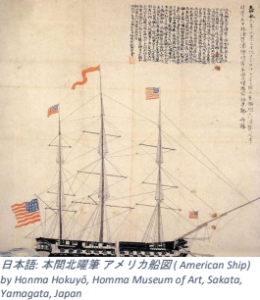 forces Butterfly’s so-called husband to grapple with the effects of his actions, it also implicates all of us who have shared in Pinkerton’s captivation as the story unfolds. As the London Times put it, “in any other than an exotic setting, the dramatic episode would be intolerably painful.” Belasco — and Puccini — rely on Japan’s “otherness” to draw us into what is, otherwise, a fairly grim story. But their vision of the geisha erases any distance between her heart and ours. In Belasco’s staged version of Madam Butterfly, Kate Pinkerton, as enchanted with Butterfly as her now-husband once was, attempts to take Butterfly into her arms, calling her a “poor little thing…pretty little plaything.” Butterfly rejects her label, then rises and asks, impassively, how long Kate and Pinkerton have been married. This a woman who will have the last word — who will die with honor as she makes all others question their own.
Puccini’s Musical Research
As Puccini sketched his scores, he looked for materials that would help him aurally “set the stage.” Madama Butterfly opens with the “Star Spangled Banner,” representing Pinkerton’s home, and goes on to quote a number of Japanese melodies. For Tosca, Puccini obtained information on Roman church bells and the appropriate melody for the Te Deum, and included a folk melody for the Shepherd Boy. La fanciulla del West contains two nods to Stephen Foster: a scrap of “Camptown Races” and a folk song based on “Old Dog Tray.” In each case, the “authentic” materials serve as a starting point for Puccini as he fashioned a sonic landscape that owed as much to his own imagination as to local modes of musical expression.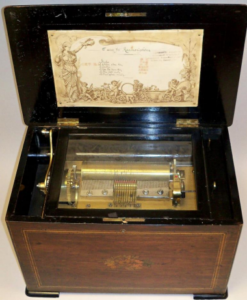
A music box, given to Puccini by Baron Edoardo Fassini-Camossi, the former Italian diplomat to China, served as the source for three of the Chinese melodies that appear in Turandot, including the folk melody “Mò Li Hūa (茉莉花)” (‘Jasmine Flower’), which serves as a leitmotif for Princess Turandot herself.
Musicologist W. Anthony Sheppard came across a music box in The Murtogh D. Guinness Collection that included tunes found in both Turandot and Madama Butterfly. In an article for the New York Times he speculates that Puccini may have encountered that very music box and used it to supplement the Japanese tunes he collected for Madama Butterfly. In this video, Sheppard explains his theory and gives us a glimpse of the music box.
The Dawn of Modern Lighting Design
Puccini’s operas contain some of the great star-making moments in opera — from “Vissi d’arte” to “Nessun Dorma.” While the composer is not alone in his ability to create show-stopping arias for singers, his Madama Butterfly offers a pair of back-to-back solos for lighting designer that are unique in the operatic repertoire.
Credit for the long, wordless dusk-to-dawn sequence must be shared with playwright/producer David Belasco, who authored the slight play that inspired Puccini’s opera, in which a similar scene created a sensation. A seminal figure in American theater, Belasco gave meticulous attention to the visual details of his productions, and an unprecedented consideration to lighting. “My conviction was that the most powerful emotional appeal could be made and the strongest interpretative power gained by the use of color and light,” Belasco wrote. “To use color, not for mere adornment, but to convey a message to the hearts of audiences, has become my creed.”
Together with his chief electrician, Louis Hartmann, Belasco created new lighting effects in an experimental electrical laboratory in the basement of his theater. In addition to developing new devices and systems, Belasco gave took pains over the human element, devoting significant time to lighting rehearsals and making exacting demands on his operators. (He sent this carefully-trained group of electricians to the Metropolitan Opera for the American premiere of Madama Butterfly in 1907.)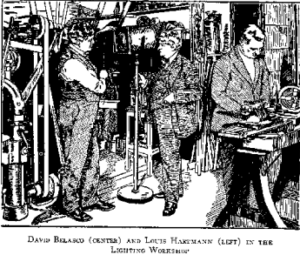
Such attention to lighting — particularly in a time when equipment was relatively unsophisticated and unreliable — was one of the things that set Belasco apart from his contemporaries. But over the next century, as technology, attitudes, and artistry have evolved, lighting design has become an integral part of operatic productions, particularly when a design is more abstract.
In 1930, the New York Times published an article summing up the collaboration between Belasco and Hartmann: MR. BELASCO AND A PASSING MATTER OF FOOTLIGHTS; His Electrician, Louis Hartmann, Says a Word or Two on Stage Lighting. Hartmann’s book, Theatre Lighting, is available via Internet Archive (free log in required).
Et Cetera
In 1852, Commodore Matthew Perry led the first of two U.S. warship expeditions to Japan, intended to force an end to Japan’s 220-year policy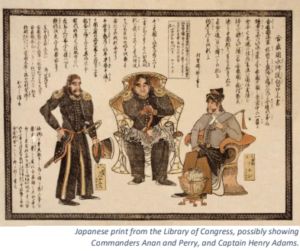 of isolation and open Japanese ports to American trade. Letters from Millard Fillmore and Commodore Perry to the Emperor of Japan during this time are available here.
The Black Ships Shock: A Historic Encounter that Changed Japan is an article by Nishikawa Takeomi (director of the Yokohama Archives of History) that uses single-sheet woodblock prints produced in the 1850s as a starting point to discuss the Japanese perspective on Commodore Perry’s arrival.
The Japanese-American National Museum (Los Angeles, CA) offers online educational resources covering a variety of topics.
From John Luther Long’s New York Times obituary: …Mr. Long called himself “a sentimentalist and a feminist, and proud of it.” The greater number of his plays and stories were written about a central feminine character, many of them bearing the inspiration’s name as a title. He also wrote extensively of the Orient, chiefly because of what he styled “the color and poetry that is Japan.”
David Belasco wrote, directed, or produced more than 100 Broadway plays, including Madame Butterfly and The Girl of the Golden West. His memoir, The Theatre Through Its Stage Door, is available online.
From the review of the premiere of Belasco’s Madame Butterfly: “The tragic note is strong and clear also while Cho-Cho-San stands all night patiently, wakefully, by the window waiting for the sailor. But, though the pictorial management of the episode, from sunset to sunrise, is novel and beautiful, the effect on the multitude may not be just what Mr. Belasco has aimed at. It is bad to make the spectators feel that they, too, are waiting.”
Producing Butterfly Today
The Asian Opera Alliance (AOA) comprises a diverse group of Asian-identified industry professionals, who join together to uplift one another and to advocate for greater Asian representation in opera, while striving for broader equity. Their website contains a roundup of resources related to Madama Butterfly.
The New York City Opera Project presents a variety of articles and essays, including a brief biography of Puccini; excerpts from his letters; a survey of the composer’s works; background on sources of the story; a discussion of Orientalism in the opera; a timeline of Italian opera; information on the disastrous first performance; and background on Puccini’s librettists.
In Madame Butterfly and my Japanese-American Experience, A.H. Nishikawa, a member of Opera Philadelphia’s Community Advisory Council, reflects on her childhood experience in the “Poston War Relocation Center,” one of the concentration camps in which Japanese Americans were sent to live during World War II.
Reorienting Madama Butterfly, a review by Alex Ross, considers Matthew Ozawa’s 2023 production, in which the story is framed as a fantasy of a modern American man addicted to anime imagery and V.R. technology.
The program for Boston Lyric Opera’s 2023 production of Madama Butterfly includes a number of resources related to both the production and the piece. Directed by Phil Chan, the production was set during World War II.
A Mother’s Choice
By Nick Richardson
This article contains spoilers.
Can motherhood unsettle the inherent Orientalism of Madame Butterfly? Though Butterfly is a beloved staple in the opera canon, its story and production history are both plagued by misunderstandings and misrepresentations of Japanese culture, deliberate or otherwise, that suggest the political, cultural, and economic superiority of the “West” over the “East.” Madame Butterfly is not only a product of this Orientalist paradigm, it also illustrates it: An American naval officer arrives in newly-opened Japan, buys a bride, then leaves her behind to return to “real” American life. Overcoming this entrenched bias is a tall order, but reading Butterfly’s role as a mother may at least offer more depth to a story fraught with stereotypes.
Motherhood changes the course of Madame Butterfly. At the start of Act II, Butterfly’s husband Pinkerton has written off their marriage, and he asks the American consul, Sharpless, to break the news. When Butterfly introduces Sharpless to her and Pinkerton’s son, Sharpless softens. He asks for Butterfly’s forgiveness for suggesting she forget Pinkerton and find a new husband. He writes to Pinkerton of his child, which spurs Pinkerton’s return to Japan. Overcome with emotion, Pinkerton cannot bear to see Butterfly or his son. He flees and asks Sharpless to retrieve the child on his behalf. The brash, pillaging colonizers are transformed: Sharpless is now less sharp and Pinkerton is reduced to cowardice and shame. Motherhood exposes a crack in the strength of American imperialism.
Feminist scholar Sara Ruddick names three actions that govern maternal thinking: to preserve the child’s life, foster the child’s growth, and make the child acceptable to society. This last aspect is of critical importance to Butterfly. Butterfly’s initial aim as wife and mother is to fully integrate into American society. She raises her son to be “American,” dressing him as a U.S. Navy sailor. Puccini further underscores the child’s American identity with the tune from “The Star-Spangled Banner” when the child first appears on stage. Though Butterfly is earnest in her attempts to become and beget an American, when she meets Pinkerton’s American wife, she realizes she will never truly be “American”; furthermore, she has embraced Western culture to such an extent that she cannot be “Japanese.” By trying to fit in, she is an instrument to her own subjugation.
Ruddick notes that in raising a child to be acceptable to society, mothers are susceptible to an “inauthentic obedience”: “fulfill[ing] the values of the dominant culture,” including those that control and oppress others, rather than practicing values that work to benefit all children. The antidotes to this inauthentic obedience are the mother’s own humility and attentive love toward her child. Butterfly’s solution to her son’s and her own cultural limbo is born from this humility and love — not a deference to American or even Japanese power, but an active choice to preserve her child given the circumstances. She gives her child to Pinkerton, and with one last directive: to remember. Anita Yavich’s costume design makes the act of remembering visible.
After Butterfly’s death, the child enters not in the sailor suit he wore earlier, but in a kimono. This costume choice suggests a hope that Butterfly’s son might carry his mother’s identity with him to the United States.
As Ruddick proclaims, “When mothers insist upon the inclusion of their values and experiences in the public world which children enter, when they determine what makes their children acceptable, the work of growth and preservation will acquire a new gaiety and joyfulness.” Butterfly herself will not live to enjoy the fruits of her labor, but there is hope that her work will make an impact. Though Butterfly’s ending is tragic and its presentation often flawed, viewing Butterfly through this feminist lens may help redeem the piece for today’s audiences.