
From the Dramaturg’s Desk: A Deep Dive into OKLAHOMA!
Synopsis
Indian Territory (now Oklahoma), circa 1906. Laurey and Curly attempt to hide their mutual attraction with a series of insults. To spite Curly, Laurey impulsively agrees to go to the dance with Jud, the hired hand. Later, she regrets her decision and admits to Aunt Eller that Jud frightens her. Meanwhile, Andrew Carnes is eager to see his fun-loving daughter, Ado Annie, properly married, and sets a price of fifty dollars for her hand. The earnestly ardent Will Parker can’t seem to hold on to any money that comes his way; meanwhile, Ali Hakim has the cash, but not the desire, to marry and settle down. At the dance, baskets assembled by the young women of the territory are auctioned for charity. The men compete fiercely for the contributions of their sweethearts. After Jud is defeated in his bid for Laurey’s basket, he reveals the depth of his obsession. When Laurey seeks comfort from Curly, the two finally confess their love. After Laurey and Curly’s wedding, Jud starts a fight and is killed when he falls on his own knife. In a makeshift trial, Curly pleads self-defense and is pronounced not guilty. Ado Annie and Will Parker appear, having settled an earlier misunderstanding, and Laurey and Curly exit in a surrey with a fringe on top.
Territory Folks
Program note for the 2026 Glimmerglass production, by Kelley Rourke
“Drama to me, in full, is simply the effect of person upon person,” wrote playwright Lynn Riggsin 1929. “Put two people in a room and there’s drama. No one could be more surprised than I at some of their incalculable actions. In the play I’m just finishing, Green Grow the Lilacs, there are a dozen examples. The play is concerned with a more golden day in Oklahoma, golden in the sense that the people I’m writing about were magnificently adapted to their environment…”
Green Grow the Lilacs — the play that was to become Oklahoma! — is not only a study of the effect of person on person, but also an exploration of the relationship between persons and their environment, in this case, what was known as “Indian Territory” in 1900. It was an environment Riggs knew well, having been born in the foothills of the Ozark Mountains, near Claremore, in 1899.
“Indian Territory” was named not for its original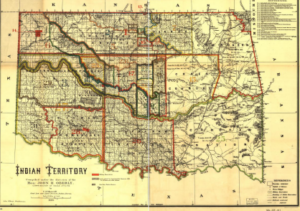 inhabitants, but for the southeastern tribes that were forcibly relocated there by the U.S. government in the wake of the 1830 Indian Removal Act. The Act, which had been approved by a narrow margin (9 votes in the Senate, 6 in the House), resulted in the removal of more than 60,000 people, representing at least 18 tribes, to land West of the Mississippi River. Due to the hardships of the journey, which came to be known as the “Trail of Tears,” many died before reaching their destination.
By the time Riggs was born, the territory once held communally by these displaced Native nations had been divided into allotments and opened to new settlers, drawing people of all races and backgrounds with a promise of opportunity and liberty. Claremore had a population of 855 and was served by two railroads (Riggs’ grandfather was a railway worker) and a post office; in the musical, it’s where Curly hires his “Surrey with the Fringe on Top.” Like the larger Territory within which it was situated, Claremore boasted a diverse population at the turn of the century. Riggs himself was of Cherokee descent.
With Green Grow the Lilacs, Riggs drew on his own memories, from his white-framed farmhouse to the tradition of the wedding-night “shivaree” to the foreign-born peddler, who also appeared in Riggs’ first play called Knives from Syria. (At the time of 1900 census, 100 residents of Indian Territory were identified as Syrian, but this seems to have been a catch-all term for all people of Middle Eastern background.) As Riggs explained, the first three acts of Green Grow the Lilacs introduce the characters; the next three constitute “the play.” With their musical, Rodgers & Hammerstein placed a love triangle at the center of the drama, with cowboy Curly and farmhand Jud (Jeeter in the play) competing for the affection of Laurey. A secondary, comic love triangle involves Ado Annie, Will Parker (who does not appear in the play) and the peddler (who is unnamed in the play).
While romance looms large in the musical, it is not the only source of tension between Riggs’ characters. As the playwright pointed out, “Curly represents one relation to the soil, Jeter another.” Rodgers and Hammerstein’s argument that “the farmer and the cowman should be friends” serves to underscore their enmity. A cowboy like Curly and a farmer like Jeeter/Jud exist as discrete points on a many-shaded spectrum, from the absolute individualism of the open range to fenced “civilization” in which difficult situations are subject to settled law. In this landscape, a peddler like Ali Hakim is a challenge to the way both understand themselves, and a figure of fascination for individuals all along the spectrum. With his itinerant existence, the peddler represents absolute freedom. At the same, by offering goods that the settlers are not able to provide for themselves, he gives lie to their claim of absolute self-sufficiency.
The drama that crackles between the characters in Oklahoma! evolves with the life experience of those who encounter it. Director Francesca Zambello, whose mother was an actress, remembers, “When I was five years old, my mother was doing summer stock on Cape Cod, where they used to perform a musical every week. I spent the evenings watching from the wings or waieng in her dressing room. Of course, that would be totally illegal now, but I got my fill of the golden age of miracles. Oklahoma! made an impression on me, and I knew all the songs by heart by the end of the summer. Little did I realize that the actual story deals with a complicated moment in history. Now, as I put it on the stage, I am transported back to that joyous time, and I’ve been working toward a production that offers the exhilaration of my first experience alongside a more serious consideration of this story.”
Oklahoma! is usually hailed for its groundbreaking integration of script, song, and dance. In The Middle-Brow Musical: Between Broadway and Opera in 1940s America (2025), James O’Leary argues that Rodgers & Hammerstein were also aiming another form of hybridity, one that blended the immediacy of commercial theater with what might be called the spiritual values of folk art. This orientation can be seen in the artists’ rejection of urban settings favored by their peers, choosing landscapes they imagined as unspoiled bastions of more stable values. Thus, the American West served the same purpose as later settings for “folk” stories, which included a Maine mill town (Carousel), Siam (The King and I), and an island in the South Pacific. Their choices were not unlike those of Giacomo Puccini, who also looked both West to the American frontier and East to Asia to express truths about the universal human condition.
Riggs wrote from what he knew, giving Hammerstein a solid base from which to create his book and lyrics. But unlike Puccini, who sought out musical references for his “exotic” locales, Rodgers was not terribly interested in authenticity. “Oscar sent me an impressively thick book of songs of the American Southwest,” remembered Rodgers. “I opened the book, played the music of one song, closed the book and never looked at it again. If my melodies were going to be authentic, they’d have to be authentic in my own terms.” For his part, Hammerstein remarked, “This is a Western landscape, and no question about it. Yet the style of these designs and the manner of painting are essentially modern. It is Indian Territory at the turn of the century expressed in the stage-design idiom of 1943.”
In their most significant departure from the play, Rodgers & Hammerstein moved the action forward six years, so the events take place on the eve of statehood; World War II was raging, and nothing short of a patriotic celebration of the Oklahoma’s statehood would do. In contrast, the unifying factor for Riggs’ territory folks is not one of race, ethnicity or occupation; it is the uncomfortable specter of someday being subject to a distant government. When Curly’s fight with Jeter turns deadly, Aunt Eller reprimands those who call for his trial: “Why, the way you’re sidin’ with the federal marshal, you’d think us people out here lived in the United States! … Whut’s the United States? It’s jist a furrin country to me.” The neighbors respond indignantly: “Why, I’m jist plumb full of Indian blood myself!” “Me, too! And I c’n prove it!”
In their adaptation, Rodgers & Hammerstein attempt to have it both ways; they celebrate both statehood and a people’s ability to come to a commonsense conclusion of right and wrong, without the intervention of a court. The 2019 Broadway production raised questions about the makeshift “trial” that ends the musical, making it seem less an act of logic and kindness than a gang of bullies protecting one of their own. This striking interpretation was accomplished without altering a word of the books or lyrics, a testament to the power of non-verbal choices.
Questions about our obligations to each other — and the government’s role in upholding these obligations — feel more urgent than ever, as do questions about our relationship to the land. Oklahoma! is set in a vanished time, one in which a “bright golden haze” obscures a bloody history. “Put two people in a room and there’s drama,” said Riggs. The drama he set in motion with the play that was to become Oklahoma! continues to crackle with tension and unresolved questions.
Lynn Riggs (1899-1954)
Lynn Riggs’s manuscript for Green Grow the Lilacs is available via the NYPL’s digital collection. A gay Cherokee writer, Riggs produced 21 full-length plays, several short stories, poems, and a television script over the course of a three-decade career. Selected items from his archives, housed at Yale’s Beinecke Library, have been digitized.
“I honestly haven’t any theories, any very definitive aims (except to be a good dramatist), and I don’t know any rules. All I am sure of is this: Drama to me, in full, is simply the effect of person upon person,” wrote playwright Lynn Riggs in 1929. “Put two people in a room and there’s drama. No one could be more surprised than I at some of their incalculable actions. In the play I’m just finishing, Green Grow the Lilacs, there are a dozen examples. The play is concerned with a more golden day in Oklahoma, golden in the sense that the people I’m writing about were magnificently adapted to their environment, heartly, vigorous, gay people. And their lives, being rounded and varied, were full of unpredictable choices…
I know more about the people I knew in childhood and youth than any others. But it so happens that I knew mostly the dark ones, the unprivileged ones, the ones with the most desolate fields, the most dismal skies. And so it isn’t surprising that my plays concern themselves with poor farmers, forlorn wives, tortured youth, plow hands, peddlers, criminals, slaveys — with all the range of folk victimized by brutality, ignorance, superstition, and dread. And will it sound like an affectation (it most surely is not) if I say that I wanted to give voice and a dignified existence to people who found themselves, most pitiably, without a voice, when there was so much to be cried out against?”
—March 13, 1929 letter to Walter Campbell of the Southwest Review
Twin Territories Miscellany
Where can a guy get a surrey around here? Claremore, originally settled by the Osage and incorporated in the Cherokee Nation in 1883, was the birthplace of Lynn Riggs and the nearest town to Laurey and Aunt Eller’s farm. By the last decade of the 19th century, it boasted a telegraph office, a butcher shop, a post office, a confectionery, grocery house, blacksmith shop, steam mill, a brick schoolhouse, three churches (Baptist, Methodist, Presbyterian), a flourmill, a lumberyard and three hotels. From The Claremore Courier, September 1, 1899: “Claremore, in her commercial rating, population, modern appearance and progressive spirit of her citizens, stands to the front among the foremost towns of the Territory.” In 1802, developer John M. Bayless opened the Windsor Opera house, which hosted live entertainment, moving pictures, and a variety of civic gatherings. Claremore had a population of 855 in 1900; that number increased to 2,866 in 1910 and has kept rising in each decade of the 20th century.
Little Wonders: This site explores everyday items that might have been in use by the characters in Oklahoma, including a butter churn, a period rocking chair, a camisole and petticoat, a stereoscope (which may have inspired Will’s dangerous “little wonder”), Jud’s girlie pinups, and more. Advertisements in The Claremore Progress give a snapshot of goods on offer in 1900.
Map it! Claremore is located 30 miles northeast of Tulsa. This map marks other locations mentioned in the musical, including Catoosa (where Ali Hakim might drive Ado Annie, or where folks might hear Curly say Laurie is his girl), Bushyhead (where Gertie might settle down to run her Papa’s store), Quapaw (where Jud worked once), Sweetwater (where the Bartlett family was burned up in a fire), or faraway Kansas City (where everything is up to date).
Claremore’s first railway station, an important stop on the “cattle trail,” dates from 1882. (Rail travel came late to the Twin Territories because midcentury treaties with the Native American tribes did not allow for railways to cross their territory; eventually those treaties, like so many others, were voided and rewritten.) The first edition of The Claremore Progress (July 7, 1900) carried advertisements for two passenger trains: The Union Progress, offering “splendid train service” on all principal western routes, with drawing rooms, sleeping cars, and steam heat; the Nebraska-Colorado Express offered a new night train from Kansas City to Denver and beyond.
“The Black Promised Land”: An article from Smithsonian Magazine discusses the history of Black settlers in the Twin Territories. In the years between the Civil War and statehood, many hoped that the allotment process could provide a fresh start, far from the violence of Reconstruction-era South, and more than 50 all-Black towns were created in the years between 1865-1920. Bass Reeves, who fled to Indian Territory after escaping from slavery in Arkansas, had a famous career as a U.S. Marshal and was said to have been the inspiration for the Lone Ranger. However, in the years following statehood, racist laws and practices from other parts of the Union slowly eroded the gains that had been made.
Drilling for Dollars, Part 1: Oil was first discovered in the Twin Territories in the early nineteenth century, and in the decades preceding statehood, the region produced more oil than any other U.S. state or territory. An article by the Oklahoma Historical Society traces the growth of the oil industry in the region over nearly two centuries. The American Association of Petroleum Geologists (AAPG) explores how the history of the Osage Nation has been shaped, for better and for worse, by the discovery of oil and mineral rights policies. Killers of the Flower Moon, a book by journalist David Grann that was made into a movie by Martin Scorsese, tells of a series of oil-motivated murders of Osage people in Oklahoma in the early 1920s. Sarah’s Oil is a film inspired by the true story of Sarah Rector, an 11-year-old Black grandchild of Creek Indians in the early 1900s, who receives a parcel of oil-rich land in Oklahoma under the Treaty of 1866, and fights against local whites trying to swindle away her inheritance.
Drilling for Dollars, Part 2: In 1903, during the drilling of a test oil well, prospector George Eaton hit a flow of what he called “radium water,” and soon a wellness industry sprang forth around the mineral water’s supposed healing qualities. (Similar attractions were an important part of the economy in villages near Cooperstown, including Sharon Springs, Richfield Springs, and Saratoga Springs.) Around the turn of the twentieth century, bathhouses in Oklahoma (and elsewhere) were important hubs of social and economic activity.
What’s in the box? The “Box Social” was a popular style of fundraiser, which generally had women prepare homemade meals for men to bid on. But there were variations on this tradition, as discussed in this article about box socials in the Woodstock area. To put together an Oklahoma-style box, start with Osage Meat Pies, sweet potato pie, and a gooseberry tart.
Chasin’ steers at the fairgrounds: Kansas City’s first cattle show was held in 1899 and soon became a popular annual event. Named the “American Royal” in 1901, the nonprofit (which still operates today) defines its purpose as championing food and agriculture.
News of the Day: The Cherokee Advocate was published by the Cherokee Nation at Tahlequah, Indian Territory from 1843-1906, with pauses due to financial challenges (1853-1871) and fire 1875-1876). Select issues are available online via the Oklahoma Historical Society. The Library Congress offers an online guide to digitized collections of Native American Newspapers.
Immigrant News: By 1910, Germans were the largest immigrant group in Oklahoma (36.5% of the population), and were served by at least 20 German newspapers. Of the other nationalities present (6.6 percent Italian, 6.6 percent Hispanic, 5.8 percent Czech, 3.2 percent Polish, and 2.9 percent French), only Czech settlers had access to newspapers in their own language.
Made in “Persia”: Traveling salesmen from the Middle Eastern countries were also part of the fabric of territory life. Annie Abdo, a Lebanese peddler active around Lynn Riggs’ childhood home, may have inspired aspects of his play. Possible Histories: Arab Americans and the Queer Ecology of Peddling is a book by Charlotte Karem Albrect that is available in a free online version; you can listen to a podcast with Dr. Albrecht here.
The Land Run of 1889 was the first opening of federal lands to non-Indian settlement in present-day Oklahoma. The Homestead Act of 1862 allowed any legal settler to claim 160 acres of public land with the ability to receive a title after five years of settlement. After the opening, an estimated 11,000 homesteads were claimed and towns sprang up across Oklahoma overnight.
Tapping Into American Identity
By Nick Richardson, Assistant Dramaturg
From the outset of writing Oklahoma! librettist Oscar Hammerstein II envisioned a song about Kansas City for Will Parker, the cowboy love interest of farmgirl Ado Annie. In his first draft, Hammerstein wrote, “The idea is that Kansas City’s got everything — but Annie. Develop this number into a dance, featuring [Will].” The song remains today, but Ado Annie is nowhere to be found in the lyrics or on stage. If the song isn’t about Will’s love for Ado Annie, then what is a song about Kansas City doing in a show set in Claremore, Oklahoma? And how does dance support it?
“Kansas City” introduces the audience to an urban versus rural conflict that never actually develops in the story. The audience doesn’t even see Kansas City; they only hear about it from Will when he returns to Oklahoma from a rodeo competition. What we glean from Will paints Kansas City as the urban foil to Claremore’s “pastoral Arcadia,” according to music professor Tim Carter. Will illustrates that city life is financially risky, sexually immoral (the burlesque), and violent (filled with weapons like “The Little Wonder”).
Will also picks up new dance moves in Kansas City. As Americans settled out West, not only did they bring their belongings, but also their dance steps. These mingled with movement practices from communities both near and far, indigenous and imported, rural and urban. Settlers also took on new movements as they worked their bodies in new ways, like farming or ranching. The frontier became a site of cultural exchange.
Beyond the moves of the streets and the land, Kansas City’s theaters hosted traveling minstrel shows that brought tap dancing to the masses. Tap itself is a product of cultural exchange, traced back to Caribbean plantations in the 17th century, where the jigs of Irish indentured servants met the “percussive, polyrhythmic dances” of enslaved Africans. Both minstrel shows and tap are “authentically American — born on American soil, products of American culture clashes, fruits of American admiration for, parody of, and re-imaginings of self and others dating as far back as (or even before) America existed,” according to author Megan Pugh.
The Glimmerglass Festival’s 2026 production of Oklahoma! includes a tap break in “Kansas City.” It’s the first time in the piece where different ensembles — farmers and cowmen — come together. The unifying force here is tap, a uniquely American dance. As these “territory folks” join together to define what it means to be both Oklahoman and American, they map these identities onto their moving body politic. “America” isn’t only a geopolitical idea; it’s embodied.
Authentic on Their Own Terms
James Lowe discusses the revolutionary score of Oklahoma! for the 2017 Glimmerglass production
“I remember that shortly before beginning the score Oscar sent me an impressively thick book of songs of the American Southwest which he thought might be of help. I opened the book, played through the music of one song, closed the book and never looked at it again. If my melodies were going to be authentic, they’d have to be authentic in my own terms.”
-Richard Rodgers, Musical Stages: An Autobiography
How did a man who grew up on West 120th Street in New York City come to compose a score which seems to define the American Southwest at the turn of the 20th century? A score that includes a song so iconic, so authentically capturing the spirit of the Great Plains settlers, that in 1953 it was adopted as the state song of Oklahoma?
Perhaps one answer lies in the process. Having already composed some 28 shows and nine films with Lorenz Hart, Rodgers was entering an entirely new collaborative relationship with Oklahoma! While working with the immensely talented but frustratingly undisciplined Hart, Rodgers had often been compelled to compose the music first and prod Hart to write lyrics to fit the melodies. But Rodgers quickly found that Oscar Hammerstein’s preferred method was just the opposite: the lyrics would come first. Before writing a single word or note, the two would famously sit for hours outside under a tree, discussing the mood and texture of each scene. By the time Hammerstein had presented him with a completed lyric, Rodgers had such a clear idea of what the music needed to say in the scene that he often would complete the song within minutes.
The result was a score unlike any Rodgers had written. The needs of the play were put above all else, and the eventual speed and ease with which the notes flowed from his pen led to an open, simple, yet strong musical language, full of spontaneity, which wonderfully suited the characters. There was no attempt to be clever, nor to impress the audience. These characters sing of their hopes and struggles from their hearts.
The tone is set in the very first scene. Resisting the urge to raise the curtain in the conventional way, with the kind of rousing production number to which musical comedy audiences were accustomed, Rodgers and Hammerstein instead went back to Lynn Riggs’ stage directions in the original play, Green Grow the Lilacs. Riggs had described a pastoral scene complete with cows, corn and a golden haze. Inspired, Hammerstein incorporated this into the simple and charming lyric of “Oh, What A Beautiful Morning,” which in turn inspired Rodgers’ easy, lilting waltz and warm, soaring melody.
Opening a show with a cowboy singing an unaccompanied folksy song from offstage while a woman sits alone on stage churning butter was unheard of at the time, but it drew the audience into the story like no dancing ensemble could.
The deceptive ease with which Rodgers painted both the scene and characters is evident in the refrain of “The Surrey with the Fringe on Top.” Notice the clip-clopping horses depicted in the accompaniment, and the flatness of the horizon in the repeated notes of the melody (“Chicks and ducks and geese”). But at the end of the phrase (“better scurry”) the melody suddenly jumps upward by a fourth, and one can almost picture the birds leaping out of the way as the surrey goes rolling by. As Curly describes the scene to Laurey, his excitement grows. Likewise, each subsequent iteration of this figure rises in pitch, leaping a fifth, then a sixth, enthusiastically arriving a full octave above where it began (“and their eyes will POP!”).
Perhaps nothing in the score captures the vitality of the characters inhabiting the play more than the rousing title song. Long sustained vocal notes crescendo, ending in an exuberant shout (“and when we SAAAAY—yeow!!”), rising a step for the next long note (“A-yip-i-o-ee-AY!”), and rising once more to culminate in the final phrase (“we’re only saying YOU’RE doing fine Oklahoma, Oklahoma, O.K.!”). There is a strength, perseverance and pioneer grit that shines through this melody, vividly capturing the can-do spirit of the southwest at the turn of the 20th century. In 1943, with the country in the throes of a world war, one can only imagine how this moment inspired great pride in what it meant to overcome adversity as Americans.
It had been eight years since Porgy and Bess, and 16 since Showboat, and audiences lined up around the block to embrace a new distinctly American musical theater work. Rodgers and Hammerstein created an honest and authentic score: nothing self-consciously clever, nothing showy, and sounding every bit like the music of the heartland. Even without that songbook.
The True Cost of a Box Lunch: Extraction Economics of Oklahoma
Kevin Harris, Dramaturgy/Titles Apprentice
In Oklahoma!’s “Box Social” Curly sells everything he has to win Laurey’s lunch for $53, the 1906 equivalent of nearly $1900 in today’s dollars. For the sake of his love, he gives up his saddle, horse, and gun — everything he needs to live as a cattle driver. It is a defining moment for his character that mirrors a larger cultural shift that accompanied the transition to statehood, in which ranging cowmen became land-owning farmers. The story of how different groups extracted a living (and then some) from the land offers a fascinating look at Oklahoma’s unfolding history.
The Indian and Oklahoma Territories were a creation of the American Government, which designated them as a home for exiled indigenous nations from the east, forcibly assimilating them into capitalist systems to survive when their traditional ways of life were made unsustainable. Before the government began to divide up the land, the wide open plains were a natural home to grazing herds. As part of the systemic elimination of indigenous culture, millions of native American Bison were exterminated to disenfranchise indigenous nations that relied on them for survival.
In their place, imported cattle breeds soon became a massive industry. Cows that might be worth a few dollars in Texas or Oklahoma could be sold for far more if driven to the growing population centers of the Northeast, or to large rail hubs like Kansas City.
In 1889, settlers flooded the territory to claim their acreage. Armed with new tools like barbed wire and early industrial farming equipment, farmers could carve out their own place to grow crops to sell to the hungry north, creating dangerous barriers to the herds and threatening ranching traditions of the cowmen.
As the territory’s gaps filled in, the economic focus pivoted from the surface of the land to what lay under it. Mines and oil wells became the new herds as Americans rushed to get up to date. Resentment and envy for the wealth drawn from the rich oil reserves on Osage land sparked violent conflicts. Indigenous and minority groups were manipulated and abused by those desperate for their new wealth. As America modernized, powerful individuals and corporations began overshadowing independent farmers and cowmen alike.
Today, a new kind of farm threatens Oklahoma’s wide-open spaces. Data centers not only require land, they drain away freshwater to cool herds of servers. Everything’s up to date and everyone’s connected, but our digital attention is just the newest resource to be mined. Screens create a web of connection that doubles as a fence to keep us isolated indoors.
The story of Oklahoma!’s farmers and cowmen is a deeply personal one, set against an exploration of the way structures of power and economic needs drive society. When the everyday lives of people in times of historical instability are sung out, their world becomes a reminder of how economic need shaped America even as the structures that drive and constrain it continue to evolve.
Finding Oklahoma in Oklahoma!: A chat with Kate Morton
Kevin Harris, Dramaturgy/Titles Apprentice
Kate Morton has sung all over the country; growing up in the Cherokee Nation in Stilwell, Oklahoma, she sang her state anthem, Rodgers and Hammerstein’s “Oklahoma,” hundreds of times. This summer Kate will add more to that count as she plays Ado Annie in her first production of Oklahoma!. In our wide-ranging conversation, Kate shared her great appreciation for the people and history of Oklahoma — both the show and the state.
Oklahoma! revolves around two love triangles, complicated by conflict between farmers and cowmen and the impending future of statehood for the territory. Ado Annie is the spirited but “silly” crux of one of these triangles, a young woman more focused on the moment than societal expectation. Ado Annie can easily be seen as lacking complexity, but to Kate, her straightforward vigor is her greatest strength.
”I think Ado Annie has this innate openness to her,” says Kate. “At her core, she’s a good person. I think that quality shines through everything she does. To the outside person it might seem that she’s impulsive or making decisions that aren’t proper, but I think it’s wonderful that she’s so open to the world.”
In Oklahoma! Ado Annie is not an indigenous character. The musical sidesteps the importance of indigeneity entirely, unlike its inspiration: a 1931 play by Cherokee playwright Lynn Riggs. Much of Rigg’s writing was inspired by his youth in the Indian Territory on the verge of statehood. Kate grew up 100 years after Riggs, but less than 100 miles away, and she can still find the sound of her home in his work.
“From a Cherokee perspective, I can find the native people,” says Kate. “I can see their relationship to the land and what’s happening with the federal government, their relationship to each other. It’s always a question of how we can break the cycle of tribal erasure that’s still going on today. If I seek the people of Oklahoma in this piece, I’ll find them. The musical shows these people’s relationship to the land, and we want to show who those people are. It’s a wonderful thing in life to know people and be known.”
Ado Annie and the cast of Oklahoma! sing, “We know we belong to the land” in the musical’s vibrant finale. Kate has learned to develop her own living relationship with the complex communities, histories, and lands of her home state. Though the last 120 years have changed many things, Kate encourages us to think about the people of Oklahoma today as well: the sovereignty of its tribal nations, the complex history of residents of all kinds, and the bond they have with the land that makes up their home. She also encourages people to have a genuine relationship with the land anywhere we visit: “Think about your intentions whenever you visit places; introduce yourself to the land that you come to; learn about the history and the culture. Build a respectful relationship; it should be two-sided.