
From the Dramaturg’s Desk: A Deep Dive into Robin Hood
Download complete print version.
Opera: A Story Told in Music
In a book, the characters come to life through a combination of words (the author’s) and imagination (yours). The narrative writing helps readers “see” anything the author can dream up.
When a book is turned into a movie, we see the world of the book through the filmmaker’s eyes. A film uses a lot less words than a book — images do most of the work of storytelling. Think about how many words it would take to describe a complicated five-minute chase scene!
When a composer and librettist work together to make an opera, they think about how music can help the audience “see” the story and characters. Music can help us feel the characters’ excitement, sadness, fear, anger, or astonishment.
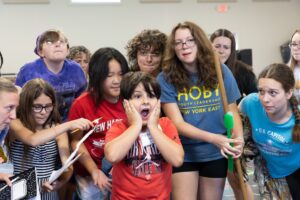
But music isn’t the only tool that opera uses to tell stories. Opera is an Italian word meaning “work,” and there are a lot of people who come together to work on an opera. The librettist writes the story/words. The composer writes the music. The director works with the set designer, costume designer, and lighting designer to imagine the world in which the story will unfold — and then costumers, carpenters, and others get to work to make that world. Meanwhile, the performers begin to rehearse. The director is in charge of the action, while the conductor keeps the music — which can be anything from a single piano to a 100-piece orchestra — on track.
Have you ever wondered how an opera gets made? Keep reading to meet some of the people who worked on this opera and learn more about what inspired them to create a modern riff on this beloved story.
Meet the Composer: Ben Moore
How did you become interested in writing music for the stage?
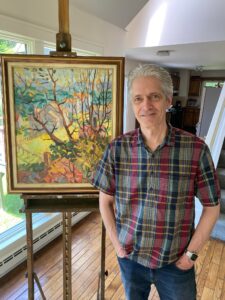
Both my parents loved to sing and perform with local theater and opera companies while I was growing up. My mom was a mezzo-soprano and
performed the famous opera role of Carmen when I was about 9 years old. I was so proud of her and also dazzled by the incredible music. I imagined writing my own opera even then. But it was many years later before I gave it a try.
Do you play any instruments?
Yes. Piano.
What did you study in college?
I majored in fine art and also took all the “pre-med” requirements (I wanted to become a doctor at that point in my life). I also took piano lessons, sang in the choir, and took a course in music theory.
What was your first opera?
Madama Butterfly. I was around 5 years old and my mom was singing the mezzo role called Suzuki.
What is one of your most memorable musical experiences?
In college I was a chorus member in Bach’s “St. Matthew Passion.” I don’t know how wonderful a performance we gave, but for me the experience was overwhelming. I’ve been obsessed with that piece ever since.
What other things are you interested in? Do they influence how you write or what you write about?
I’m a visual artist. I work with oil paints and my favorite subjects include landscapes and scenes of New York City where I live. Painting and composing are very different, of course, but the creative process can feel quite similar.
What advice do you have for young artists?
If you’re passionate about art, music, dance, or theater, then I believe you should pursue your passion while also keeping your options open. Even if your art doesn’t become your main focus, it will definitely enrich your life!
Meet the Librettist: Kelley Rourke
How did you become interested in writing for the stage? 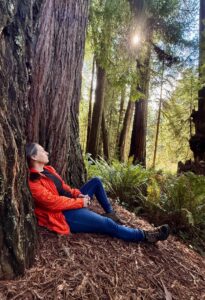
As a kid, I had my nose in a book for most of my waking hours. (I used to get in trouble in school for reading a book in my lap instead of paying attention during class.) I also loved playing piano and singing. When I landed an internship at Glimmerglass in 1994, I was thrilled to discover an art form that combines my two great loves: storytelling and music.
Do you play any instruments?
I’ve played piano most of my life. I’ve also played flute and organ, and I sang in choirs all through middle school, high school, and college.
What did you study in college?
My undergraduate degree is in piano performance.
What was your first opera?
When I was in junior high, my music teacher was in Carmen and arranged for us to come to a dress rehearsal. I don’t remember much about it, except that she told us that the fake blood (for the fight in the first act) contained peanut butter to make it stick.
What is one of your most memorable musical experiences?
My first summer at Glimmerglass made a huge impression on me. At that point, I was spending hours and hours alone practicing the piano, figuring out what I wanted to express in my performances and honing the technical skills I needed in order to do so. When I got to Glimmerglass, I found myself in rooms full of people — singers, conductors, directors, designers — who had all spent long, lonely hours getting to know a piece, deciding what they wanted to say, and developing the skill and craft to do so. And then, they came together in rehearsals — and changed each other’s minds! Not only did I see singers’ interpretations change, I saw scenery and costumes transformed from one rehearsal to the next, as each team worked together to bring each story to life. I was hooked.
What other things are you interested in? Do they influence how you write or what you write about?
Although I don’t play piano professionally anymore, I still enjoy sitting down at the piano, and my musical knowledge informs my work as a librettist. I also enjoy gardening. When I’m stuck on a writing project, sometimes I need to put down my pencil and pull a few weeds, or take a long walk. When you’re making something, sometimes you need to let your mind roam free.
What advice do you have for young artists?
Take in as much as you can — and not just in your own art form. Read novels and poetry. Go to museums. Find someone to make music with. See plays, operas, films. You never know where your curiosity will lead you!
What’s the Story? Reimagining Robin as an Opera
When the law of the land is corrupt, what’s an honest citizen to do? In the absence of the King, the Sheriff has seized the country’s assets for himself. Robin Hood flees to his beloved Sherwood Forest, where he finds himself leading a band of ordinary folks to create a new kind of society, much to the dismay of the Sheriff and his comically incompetent quintet of deputies. A sensitive soul, Robin struggles with the role that has been thrust upon him. Can he be a leader without being a fighter? Will he ever gain the respect of Marion, his second-in-command? And when the King does return, will Robin and his friends be seen as heroes or outlaws?
Synopsis
The Sheriff, backed by his deputies, proclaims his dominion over the land, which he sees as a valuable resource to be exploited (“Law and Order”). When the Sheriff hears rumors of a rebel living in the forest, he commands his deputies to “find that Hood and drive him out.”
Robin Hood sings of his wish to leave the Sheriff’s version of “civilization” behind (“A Hummingbird’s Life Would Suit Me Fine”). Scarlet, a mysterious bird-like creature, appears to Robin and encourages him to step up to head the resistance (“Lead with Love”).
One by one, disgruntled citizens appear, singing of the Sheriff’s injustices (“The Sheriff Passed a Law”). Marion whips up the crowd (“I Say”) and their anger builds, threatening to turn violent. Robin, remembering Scarlet’s message, encourages the people to band together to create a new kind of order (“Now Is the Time”).
Ronnie and Jackie, two of the Sheriff’s deputies, come upon Robin, alone. In the comical fight sequence that follows, Robin never throws a punch, but the two deputies, by sheer ineptitude, manage to knock each other out. The Merry Band appears (“Home in the Wilderness”). With Robin and Marion, they provide alternatives to the “facts” the deputies have learned from the Sheriff (“Under Good King Richard”). Moved, the deputies pledge allegiance to the Merry Band, not realizing that Scout, another of the Sheriff’s deputies, is spying nearby.
The Sheriff is furious to hear of Ronnie and Jackie’s desertion, and even more furious that Robin continues to evade him. To draw Robin out, the Sheriff plans an archery contest. Although none of the Sheriff’s crew has seen Robin, the Sheriff is sure he’ll know him on sight. Robin and Marion, coming upon a notice for the contest, each try to convince the other to join (“No, You”). As they sing, their shy admiration for each other becomes apparent.
The Sheriff rigs the archery contest, but Robin easily wins and escapes with the bag of gold; only after he has fled does the Sheriff realize he’s been foiled again (“I Curse the Day”). Robin, flush with victory, temporarily loses sight of his goal and must be reminded by Scarlet (“In the Middle of It All”). But before Robin knows what has happened, he is jumped by three deputies; Marion attempts to help, but this time the deputies get the upper hand. When the Deputies go to find the Sheriff, Robin and Marion confess what is in their hearts (“Different”). Before the Deputies return, the Merry Band appears and rescues them (“Now Is the Time” – reprise)
The King returns (“When the King Takes the Crown”) and has a chance encounter with Robin; each recognizes a kindred spirit, though neither of them realizes who the other is at first. The Sheriff stumbles in and tries to reframe the situation for the King, to no avail. However, encouraged by Robin and the Merry Band, the King forgives the Sheriff, who sees the error of his ways (“Now Is the Time” – reprise).
Who Was the Real Robin Hood?
Lithe and listen, gentleman,
That be of freeborn blood;
I shall you tell of a good yeoman,
His name was Robin Hood.
—A Gest of Robyn Hode, 15th century
The story of Robin Hood has been told for hundreds of years, and historians and fans alike have been searching for him all the while. Finding the original “Robin Hood” is tricky for two reasons: In Medieval Britain, “Robert Hood” was a common name, and by the 13th century, “Robehod,” “Rabunhod,” and other spellings were a familiar nickname for criminals. Check out the timeline below to trace Robin Hood’s history over the centuries.
1226: According to English criminal court records, Robert Hod has his belongings seized and is named an “outlaw” — someone who failed to appear in court for a crime, so he is out of the protection of the law.
1261: Court records state that William, the son of Robert le Fevere, lost his possessions to a religious order. The following year, court records call him “William Robehod” — but the legend of Robin Hood may have already existed before then!
1377: The first mention of Robin Hood in literature appears in the narrative poem “Piers Plowman” by William Langland.
15th Century: A Gest of Robyn Hode is one of the oldest and lengthiest writings on Robin Hood still in existence today. Featured are the Sheriff of Nottingham and Robin’s “merry men,” including Little John and Scarlock. The ballad includes some key elements in the legend, such as Robin’s strong moral code, his devotion to the Virgin Mary, and the Sheriff’s archery contest. Surprisingly, there is no mention here of Robin stealing from the rich to give to the poor, though he did help the less fortunate in other ways.
Little John and good Scarlock
Were archers good and free;
Little Much and good Reynolde,
The worst would they not be.
When they had shot about,
These archers fair and good,
Evermore was the best,
For sooth, Robin Hood.
—A Gest of Robyn Hode, 15th century
1521: In his History of Greater Britain, Scottish historian John Major introduced more “facts” about Robin that became part of the legend. He wrote that Robin Hood lived during the reign of King Richard I (from 1189 to 1199), and that “he would allow no woman to suffer injustice, nor would he spoil the poor, but rather enriched them from the plunder taken from abbots [abbeys].”
1590s: Robin Hood appears on stage in a few Elizabethan plays. Anthony Munday’s two-part play ties Robin’s identity to Robert, Earl of Huntington, suggesting Robin was a disgraced nobleman. Munday also adds Marion, who, up to this point, has rarely been mentioned in any ballads of Robin Hood. Shakespeare mentions Robin Hood in a few of his plays: Two Gentlemen of Verona (1592), Henry IV, Part II (1597-1598), and As You Like It (1599).
They say he is already in the Forest of Arden,
and a many merry men with him; and there they
live like the old Robin Hood of England.
—As You Like It, Shakespeare (I.i.113-115)
1883: American author Howard Pyle’s The Merry Adventures of Robin Hood takes the many ballads and stories of Robin Hood and synthesizes them into one clear children’s book. He modernizes the language to make Robin Hood even more accessible. The book is a smash hit, and it launches a new wave of interest and fans. You can read the whole book and see Pyle’s groundbreaking illustrations all for free at Project Gutenberg.
Your Turn!
Who would your version of Robin Hood be in 2026? What would they fight for? Who would be part of their circle of friends? Talk about it with your friends — you can create a new Robin Hood story together!
Rob-in-Media: Modern Adaptations
Rob-in-Film
Robin Hood… the fox? Disney’s animated telling of Robin Hood holds two notable firsts: it’s the first Disney film approved and made after Walt Disney’s death, and it’s the first Disney film to feature an entire animal cast. (Save those facts for trivia night!) You can watch the trailer here and stream the movie on Disney+.
Double Feature: 1991’s Robin Hood: Prince of Thieves was a blockbuster hit with a star-studded cast, including Kevin Costner, Alan Rickman, and Morgan Freeman. Mel Brooks used the plot of Prince of Thieves for his Robin Hood parody, Robin Hood: Men in Tights, two years later. The title song remains a perennial favorite in the Mel Brooks catalog.
Seeing Green: Robin Hood makes an appearance in the first Shrek film, interrupting Shrek and Princess Fiona’s return to Duloc with a song and dance.
“Happily ever after”? In the ABC television series Once Upon a Time, fairytales, Disney films, and children’s literature collide. Robin Hood steals Rumplestiltskin’s magic wand to try to save his wife, Marian, but is unsuccessful. He later learns that he is the prophesied true love of Regina, the Evil Queen.
Classic Robin: The Adventures of Robin Hood from 1938 remains the touchstone for Robin Hood films. It starred two of the biggest actors of its time, Errol Flynn and Olivia de Havilland. Nearly 60 years later, Congress added it to the National Film Registry for its significant cultural impact. You can watch it for free on Tubi.
From their Flying Circus, Monty Python’s version of Robin Hood is “Dennis Moore,” a man who steals from the rich to give to the poor… only don’t expect him to steal any valuables.
Rob-in-Music
Country music legend Roger Miller voiced Alan-a-Dale in Disney’s Robin Hood and contributed many songs to the film’s soundtrack. This Spotify playlist pulls the songs from various Disney albums to make the full soundtrack available. (Fun fact: Miller would later write the music and lyrics for the Broadway musical Big River, winning a Tony Award for Best Original Score.)
Known for their blend of traditional Celtic music and pop, Irish band Clannad created the soundtracks for many films and TV shows. They won a BAFTA (British Academy of Film and Television Arts) for Best Original Television Music in 1984 for composing the soundtrack of the UK TV series Robin of Sherwood. Their music video for the theme song, “Robin (The Hooded Man)” includes clips from the TV show. You can listen to the award-winning soundtrack, Legend, on Spotify.
Calling all Millennials: Did you know the viral hit “The Hampster Dance Song” samples music from the opening credits of Disney’s Robin Hood? Check it out for yourself in this mashup!
Rob-in-Books
British children’s author Michael Morpurgo (best known for War Horse) tells Robin Hood as a story within a story. After discovering a human skull, a young boy faints and dreams of Robin. The novel follows Robin’s whole life story, from saving his father from the Sheriff, to joining the disabled Outcasts in Sherwood Forest, to falling in love with Marion. Originally published in 1996, Morpurgo’s novel got republished in 2012 as Outlaw: The Story of Robin Hood.
Robin Hood… the worst? Newbery Medal-winning author Robin McKinley makes Robin the worst archer of the bunch in her novel The Outlaws of Sherwood. One bad shot of his arrow sends Robin on the run. He’s not skilled, and he’s not very brave, but with his friends Much and Marian, he slowly develops a following of other outlaws — including many new female characters.
Triple Threat: Before she was Maid Marian, she was Mary, an orphan hiding in the woods to avoid an arranged marriage. Theresa Tomlinson’s ForestWife trilogy tells the story of Robin Hood from Mary’s point of view. Centered in these novels are the women of the forest who use their brawn, brains, and even magic for justice.
Sheriff Says: Author Michael Cadnum takes the Sheriff of Nottingham’s side in his spin on Robin Hood. In a Dark Wood follows the Sheriff as he aims to take down Robin. Warning: It’s a gory book with torture scenes!
Rob-in-Theater
Who needs a man in tights when you can have a woman? In Marian, or the True Tale of Robin Hood by Adam Szymkowicz, the real “Robin Hood” is actually Marian in disguise. As she and her merry friends (not all men!) fight the greedy Prince John, they learn what it takes to be your true self in a world that doesn’t allow it.
Lend Me an Outlaw: Ken Ludwig’s prolific catalog of plays and musicals includes Sherwood: The Adventures of Robin Hood. His Robin Hood doesn’t start as the hero we all know, but as a guy just looking to have fun. The San Diego Union-Tribune called Ludwig’s take “fun, frothy summer entertainment!” (Fun fact: Ken Ludwig’s “jukebox opera” Tenor Overboard premiered at Glimmerglass in 2022.)
Lead with Love: Stories of Nonviolent Resistance
Robin Hood is famous for his bow and arrow, but the true power of his protests against the Sheriff of Nottingham come from uniting the people to work together in protest of unfair laws, taxes, and militarism. There is a tremendous history of brave leaders from around the world who have taught their own practice of peaceful resistance and nonviolent protests, refusing to compromise their own morals or hurt others to achieve their dreams for a better future. Here are some great examples to learn from.
Amanda Gorman (1998–)
Amanda Gorman gained national attention when she read her poem “The Hill We Climb” at the inauguration of President Joe Biden. She was only 22 years old — the youngest poet ever on the inauguration stage. She writes poems, novels, and children’s books to promote healing and unity. Watch her read “The Hill We Climb.”
March for Our Lives (2018–)
After the mass shooting at Marjory Stoneman Douglas High School in Parkland, Florida in 2018, student organizers channeled their grief into massive public advocacy, organizing over one million people for a synchronized, peaceful march on Washington to demand gun safety legislation. This youth-led movement continues to host many events in person and online with the goals to “Confront Apathy, Mobilize Youth, and Cultivate Leaders.” Watch 11-year-old Naomi Wadler’s speech at the March for Our Lives rally reminding attendees of the Black girls who have died from gun violence.
Greta Thunberg (2003–)
At age 15, Greta Thunberg began protesting the climate crisis through a “strike from school” and sitting outside the Swedish parliament for three weeks in 2018. This turned into a 251-week peaceful protest and inspired people globally to see the urgency of climate action and led her to speak at the UN’s Climate Action Conference. Her work evolved into the organization Fridays For Future, a youth-led climate activist group that has organized protests in over 7,500 cities around the world. Their website has great resources to get your activist work started, including a “How-To” guide.
Malala Yousafzai (1997–)
Malala began publicly campaigning for girls’ education in Pakistan at just 11 years old. When the Taliban banned girls — including her — from attending school, Malala started a blog to speak out and share her experiences. Her efforts led her to speak at the United Nations and earned her the Nobel Peace Prize in 2014 — the youngest recipient ever of the award. Watch Malala and viral comedian Julian Shapiro-Barnum teach 6th graders about peace in this episode of Celebrity Substitute.
Estonian Singing Revolution (1987–1991)
Singing can change the world! After 50 years of occupation involving violence and terror, Estonians wanted independence from the Soviet Union. In 1988, hundreds of thousands of Estonians gathered in public arenas to sing forbidden national hymns. This weaponization of cultural heritage culminated in the “Baltic Way,” a chain of two million Estonians, Latvians, and Lithuanians holding hands for over 400 miles. Though Estonia did not have its own army or even its own weapons, it was able to gain independence through peaceful protest. Check out this trailer for the documentary The Singing Revolution.
Rigoberta Menchú (1959–)
As a young adult, Rigoberta Menchú lost her brother, father, and mother to violent extremists during a civil war in her country, Guatemala. Rather than fighting back, Menchú taught herself Spanish and other regional languages so she could educate fellow indigenous Guatemalans about peaceful ways to protest. She organized demonstrations, boycotts, and strikes to weaken the government. She later became an author and international advocate for indigenous rights, earning the Nobel Peace Prize in 1992. Learn more about Menchú in this free episode of the Rebel Girls podcast.
Ruby Bridges (1954–)
When Ruby was just six years old, she walked into a once-segregated elementary school in New Orleans, despite enraged protests from the community. Her quiet courage made her a beacon of peaceful resistance in a time of violent segregation. Her story was made into a TV movie by Disney in 1998. Watch the trailer here, and stream the entire film on Disney+, Amazon, or YouTube.
Little Rock Nine (1957)
In September 1957, nine Black students faced down angry white mobs and the Arkansas National Guard to integrate Little Rock Central High School. Trained in nonviolent discipline by the National Association for the Advancement of Colored People (NAACP), their quiet, courageous persistence forced a federal intervention and put the rule of law to the test. Do you like to dress up for the first day of school? See what Carlotta Walls of the Little Rock Nine wore on her first day in this special story from the National Museum of African American History and Culture.
Dr. Martin Luther King, Jr. (1929–1968)
Martin Luther King, Jr. led the American Civil Rights Movement from 1955 until his assassination in 1968, organizing mass economic boycotts, peaceful marches, and deliberate acts of civil disobedience. His wife, Coretta Scott King (1927–2006) championed the movement alongside him and carried his work forward for decades. Check out this animated version of Dr. King’s famous “I Have a Dream” speech from 1963.
Harry Belafonte (1927–2023)
Harry Belafonte was an American singer and actor who used his stardom to fund the Civil Rights Movement, bankrolling the Freedom Rides and voter registration drives in the 1950s and 1960s. He was one of Dr. King’s closest confidants, demanding King join him on The Tonight Show to speak, and frequently raising bail money to release him and other nonviolent protestors from prison. Later Belafonte would lead the creation of the song “We Are The World” with Michael Jackson and Lionel Richie. How many famous singers do you recognize in the music video?
Rosa Parks (1913–2005) and Claudette Colvin (1939–2026)
You may have heard of Rosa Parks, who refused to give up her seat on a Montgomery bus in 1955. Her actions launched a 381-day transit boycott until the Supreme Court ruled racial segregation on transit unconstitutional. Did you know that Claudette Colvin was arrested for the same thing, nine months before Rosa Parks? She was only 15 years old!
Nelson Mandela (1918–2013)
Nelson Mandela was a South African revolutionary who fought against the legalized racial segregation in Africa known as apartheid. After 27 years in prison, Mandela chose a path of national reconciliation over retaliation to dismantle systemic racism. He led disciplined political negotiations and mass peaceful mobilizations, working closely with Archbishop Desmond Tutu to transition the country into a multi-racial democracy. Read more about Mandela’s life and work in this free graphic novel from the World’s Children’s Prize.
Desmond Tutu (1931–2021)
Laughing all the way to freedom was Desmond Tutu, the first Black Anglican Archbishop of Cape Town and Johannesburg, South Africa. He used his pulpit to preach nonviolent resistance, organizing massive peaceful marches and advocating for international economic sanctions to resist the South African apartheid regime. He was later appointed by his close ally Nelson Mandela to chair the Truth and Reconciliation Commission, which investigated crimes during the apartheid era. Check out the Disney Channel Original Movie The Color of Friendship to see the true story of how two girls faced apartheid — and each other. (Trailer here, full movie on Disney+)
Mahatma Gandhi (1869-1948)
Meet the “Great Soul” himself: Gandhi was an Indian lawyer and leader who worked to gain India’s independence from Britain. He created a determined practice of nonviolent protest known as Satyagraha: “holding on to truth.” He may be most famous for organizing the Salt March, a 240-mile walk to the Indian Ocean in protest against Britain’s taxation of salt. Learn more in this introduction from BBC Bitesize.
Suffragists (Active late 19th Century–1928)
Did you know women in America have only had the right to vote for about 100 years? The Suffragists (suffrage means the right to vote) were a diverse political movement of women who campaigned for the right to vote through highly organized public rallies, massive marches, and targeted hunger strikes. While Suffragettes used radical property damage, the mainstream movement of Suffragists relied heavily on peaceful, sustained civil disobedience to secure voting rights across the globe. The musical Suffs by Shaina Taub (2024) tells the stories of some of these brave women. You can watch the whole musical for free until July 31st on PBS’s website.
“Being Different Makes Us the Same”
Think about the protagonists (the heroic main characters) of your favorite books and movies. What makes them so special? They all have something that makes them different from the people around them. Some of them have special powers, like Harry Potter, Spiderman, and Elphaba. Sometimes they are outsiders in a new place, like Cady Heron in Mean Girls, who attends an American high school after being homeschooled in Africa her whole life. Some characters simply have different interests than their peers. In To Kill a Mockingbird, Scout doesn’t want to play with tea sets or wear dresses; she likes to get dirty, play with bugs, and roughhouse. Some characters check all these boxes. Esperanza in The House on Mango Street is an observant writer, and as she grows up in a new neighborhood, she notices the things that make her different from others: her skin, her poverty, her preference for solitude.
These differences take characters (and readers) on extraordinary adventures. More often than not, when things get difficult on these people’s journeys, it’s their differences that help them keep going and succeed. Percy Jackson, for example, struggles in school because of his ADHD and dyslexia. As he travels the country in search of Zeus’s lightning bolt, his weaknesses in school become assets on the battlefield. Katniss Everdeen doesn’t have time to be a kid; she has to hunt and forage in order to support her family. Those skills save her when she competes in the Hunger Games.
If only these differences were enough! No hero or heroine perseveres completely on their own; they have friends around them to lift them up when they fall. These friends have something that makes them different, too. It’s the combination of differences — and supporting each others’ differences — that makes life possible. Jo March from Little Women wouldn’t pursue a career as a writer without her sister Beth’s encouragement (a special power in itself). Where would Dorothy be without the Scarecrow, the Tin Man, and the Lion? All four of them have something that makes them different, and it takes teamwork to reach the Wizard of Oz and stop the Wicked Witch.
Our two protagonists, Robin and Marian, don’t behave how others expect them to. They have unique interests and they approach life differently. They’re not just different from other boys or girls, they’re different from each other, too. What they share is respect for each other. Together, they can take on the Sheriff of Nottingham, and, perhaps even harder, they can change the hearts and minds of their community for the better.
Your Turn!
What are the things that make you different from your peers? How have those differences helped you navigate life? Who are the friends that support you? How do you celebrate each other’s differences?
This Land Belongs to All of Us: U.S. Public Lands
The Sheriff of Nottingham sees Sherwood Forest as a source of cash, but Robin and his friends know that there is immeasurable value in wilderness that remains wild. In the U.S., the National Park Service was created in 1916 “to conserve the scenery and the natural and historic objects and the wild life therein and to provide for the enjoyment of the same in such manner and by such means as will leave them unimpaired for the enjoyment of future generations.” Today, almost one third of the U.S. is set aside as parks, forests, and preserves for the good of nature and for everyone to enjoy. More than 840 million acres are protected this way — that’s more than 600,000 football fields!
America is famous for its natural wonders and parks make up many of these, whether they’re national parks like the Grand Canyon, or a neighborhood park down the street. These spaces provide opportunities for becoming acquainted with a staggering variety of natural wonders — from a towering redwood to a delicate monarch butterfly. Many of these areas are also protected lands, which means they must be managed in a way that preserves biological diversity.
Protected lands…
…keep the air clean. Did you know plants produce oxygen as they breathe? They also clean it! All the protected forests filter carbon and pollutants out of the air – up to 50 million cars worth! The muddy microorganisms in swamps and wetlands can clean air up to 10 times faster than trees.
…and the water. Forest, prairie, and mountain ecosystems also clean the water.
…keep animals safe. Many national parks have “celebrity” species: think of bison in Yellowstone, alligators in the Everglades, Elk in Rocky Mountain. But national parks also provide important habitat for less-famous threatened and endangered species, from the Shenandoah salamander to the Olympic marmot.
…help animals travel. They also provide wildlife corridors for migrating animals like deer, elk, and birds to travel cross-country without getting blocked by dangerous highways.
…contribute to the well-being of homo sapiens! Research shows that time spent in nature supports mental and physical health. In addition, the majesty of mountains, waterfalls and other features of the landscape can inspire awe, a complex and beneficial emotion that is the subject of a recent book by Dacher Keltner.
But they’re in danger.
Wildfires, pollution, poaching, and extractive industries are all severe dangers to public lands and the plants, animals, and people that need them! Every year humans chop down trees, start accidental fires, and dump garbage in water systems.
You can help!
You don’t need to live in the woods like Robin Hood to help the forest.
Here’s some easy ways to help!
- Visit parks and learn about the public lands around you! Most national parks and monuments have Junior Ranger programs where kids can earn special badges and work with rangers. (Parents can do it too!)
- Talk to your friends and family. Encourage them to get involved in local community organizations with you!
- Leave no trace! When visiting public lands, pack out your trash and pick up garbage when you see it.
- Wherever you are, practice the 3 R’s of waste management: Reduce, Reuse, Recycle.
Your turn!
New York State is full of beautiful forests, lakes, beaches, and even swamps full of amazing animals, plants, and people. Take the time to get outside this year so you can explore them!
Try to find the places nearest to where you live, or search for these spots near The Glimmerglass Festival!
- Goodyear Swamp Sanctuary (on The Glimmerglass Festival campus!)
- Glimmerglass State Park (2.5 miles away)
- Owen D. Young Nature Trail (8 miles away)
- Wintergreen Park (24 miles away)
- Mine Kill State Park (34 miles away)
- Adirondack Forest Preserve (42 miles north)
- More than 9000 square miles in size! Bigger than the state of Vermont!
- Chittenango Falls State Park (49 miles away)
The Major Oak
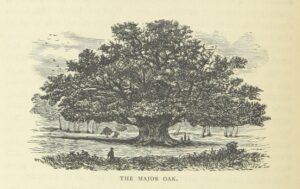
In June 2026, Sherwood Forest’s “Major Oak” was pronounced dead. Between 800 and 1200 years old, the tree has long been associated with the legend of Robin Hood; its wide, hollow trunk was said to have been the place where Robin hid his loot.
Many factors contributed to the decline and death of the massive English Oak, whose canopy was once more than 90 feet across. Years of tourist traffic compacted the soil around its roots, and today’s changing climate brought record heat waves and long, dry summers. Well-meaning conservation efforts — including lead sheets and iron braces added for protection and support — ultimately played a role in weakening the tree.
An oak tree is an ecosystem unto itself, supporting the life cycle of over 2,000 different species, including birds, mammals and insects. Robin’s tree will be left to stand and decompose in place; as it decays, the giant will ultimately host more species than it did while it was alive.
An opera performance is ephemeral, but after the final curtain falls, there is a lot of stuff to deal with — scenery, props, costumes. Whenever possible, Glimmerglass follows the three Rs of waste management:
- REDUCE consumption by buying only what you need
- REUSE existing items by repurposing them
- RECYCLE materials like paper, glass, and metals to conserve resources
After a show’s run has ended, Glimmerglass staff consider next steps for scenery, props, and costumes. Many complete productions are stored in our warehouse and rented out to other opera companies, allowing renters to reduce their own consumption. Odyssey is one example of a popular rental: the Cyclops has roared in Cooperstown (twice!), Detroit, and New York City; later this year he will travel to Washington, DC. Other frequently rented Glimmerglass productions include La Traviata, Candide, West Side Story, and The Sound of Music.
If no one wants to rent a production, sometimes parts of it can be reused.
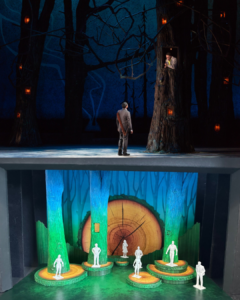
Our 2015 production of The Magic Flute featured several realistic 25-foot trees made of steel and foam. When scenic designer James Rotondo saw them in the warehouse, he was inspired to use them to create his own vision of Sherwood Forest.
Sometimes, a production is unlikely to be either rented or reused. In those cases, the scenery is broken down into component parts (wood, steel, etc.) that can be recycled. During the Covid-19 pandemic, Glimmerglass built an outdoor stage to keep artists and audiences safe. After we moved back into the theater, the outdoor stage was disassembled and the lumber recycled.
The natural beauty of Central New York is one reason that visitors travel here from around the world, and by following a policy to reduce/reuse/recycle, The Glimmerglass Festival is doing its part to help protect that landscape. These practices make good business sense, too — our scenery budget goes further when we don’t always have to start from scratch.
Rail Against Your Dying Day
In 2017, Rachael Powles, then a second-year member of The Glimmerglass Festival Youth Chorus and a senior at Sauquoit Valley High School, reflected on her experience as part of the original cast of of Robin Hood.
After my extraordinary summer performing in La bohème in 2016, I was thrilled to be cast as Sam the Scribe alongside sixteen other brilliant youth performers in the world premiere of Robin Hood. Admittedly, I was nervous going into the 2017 season. I had never been part of a world premiere, nor had I ever worked with a living composer or had a schedule that demanded my presence six days a week. Nothing could have prepared me for what I experienced in those three exhilarating months, and thanks to The Glimmerglass Festival, I have a new perspective on the ways opera can have a lasting impact on people’s lives.
Ben Moore and Kelley Rourke’s interpretation of Robin Hood focused on a ragtag group of children standing against the grownup forces pushing them into submission. I played both a member of the Merry Band and one of the Sheriff’s deputies, so I had to jump between the opposing worlds very quickly. The malicious world of the Sheriff was stiff and artificial, with shallow values and hardened hearts. The Merry Band, on the other hand, believed in justice and equality, even as the forces around them promoted a less idealistic vision of “law and order.” Robin and friends fought to separate themselves from the artificial world and find value in what came naturally.
Whenever I was with the cast, I could feel their excitement and their determination. From our first rehearsal, I had no doubt in my mind that the production would succeed; we would all memorize our music, we would all learn our stage directions, we would all immerse ourselves in this story. Each of us used every ounce of energy to make this show happen. No one went halfway at Glimmerglass. There was nobody here just to say they had an extracurricular activity, and no one stopped being your friend if you had the role they wanted. Everyone was there because they wanted to be, because this was their favorite thing in the world. Just like the characters we played, we were fighting to make a name for ourselves, to live life to the fullest, to be the best human beings we could be.
Over the course of the summer we grew comfortable enough with each other to be ourselves without shame. We were the Merry Band onstage and off, a collection of outsiders tossed together who just wanted to give the world something to think about. It’s exhilarating to watch your friends disappear into their characters. I remember one performance, in the darkness of backstage, a group of us were murmuring on about the pros and cons of our favorite superheros, but the moment our stagehand told us to stand by, we put our conversation on hold, and thirty seconds later we were onstage singing “Law and Order.” Sometimes from the stage, I could see my castmates in the wings dancing and laughing, then moments later they were beside me, completely unrecognizable.
The Glimmerglass Festival’s insistence that children be welcomed in this art form has breathed new life into opera. I am a natural storyteller, and for me, opera merely is another method of storytelling, another way to keep people thinking about the world and their responsibilities to it. My castmates and I agree that before we found Glimmerglass we had no idea opera was a genre we ever thought to explore. In my opinion, Robin Hood was so popular because it broke down the idea that opera was something only adults could appreciate. This was most evident whenever there were children in the audience. At every performance there was always at least one child in the front row watching us with rapt attention, soaking up our performance. We often had young fans come up to the stage door armed with pens, displaying their programs for us to autograph. Sometimes they timidly asked for pictures, and we happily complied, since in their minds we really were the Merry Band. I asked one little girl, no older than seven, if she wanted to be in an opera one day. She thought for a moment, then concluded, “No, I just like to watch.”
As much as we need storytellers in this world, we need an audience for those stories even more. The children who came to see Robin Hood are the next generation of audience members. Glimmerglass has created an environment where the youngest among us are free to explore the world of opera without judgement, to learn stories of trials and triumphs in entertaining ways. I don’t know if those audience members will ever come back to opera, but I dearly hope they will carry the story we told as they go about their lives.
Looking back, all of these facts seem so obvious, but in the moment I had a hard time wrapping my head around the themes of Robin Hood. I was more concerned with navigating the patterns of neon tape, keeping track of daily lyric changes and trying not to trip over my own feet. The themes did not seem as important as the singing and blocking. The pieces all fell into place one rehearsal during our lunch break, when the topic of conversation turned to our favorite bands. Shane Bray (Ronnie the Riveter) declared that The Lumineers were better than a rest and put on their song “Sleep on the Floor” to prove it. I’ve been a Lumineers fan for years, but that day I listened to the song in a new way. The chorus goes in part, “Will you lay yourself down and dig your grave, or will you rail against your dying day?”
That was when it hit me. This was our Robin Hood. The Merry Band, the Deputies, the Sheriff himself, all make the conscious choice to rail against their dying days in one way or another. Their world, just like ours, was a work in progress, but did they did everything in their power to keep it from falling to pieces. I am proud to have been part of a production with such an important message. I am proud to have shown young people the power of music and storytelling. Most of all, I am proud to continue fighting with the force of the Merry Band for my right to be heard, and I am eternally grateful for The Glimmerglass Festival for keeping opera alive for the younger generations.